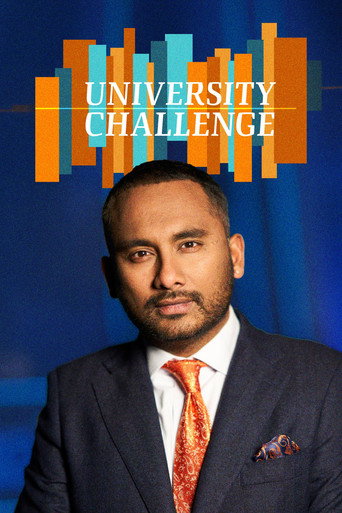
University Challenge (1962)
รายการวาไรตี้ซีรี่ย์ 1962ทอล์กโชว์
- ชื่อภาษาอังกฤษ
- University Challenge
- ประเทศ
- สหราชอาณาจักร
- ออกอากาศครั้งแรก
- 21 กันยายน 2505
- จำนวนตอน
- 2058 ตอน (56 ซีซัน)
- ความยาวต่อตอน
- ประมาณ 29 นาที
- สถานะ
- ยังฉายอยู่
- ตอนล่าสุด
- EP13/15 (5 ตุลาคม 2569)
- ตอนถัดไป
- 12 ตุลาคม 2569
- ช่อง/แพลตฟอร์มต้นทาง
- ITV1, BBC Two
- คะแนน TMDB
- 6.5/10 (13 โหวต)
เรื่องย่อ University Challenge
University Challenge เป็นรายการวาไรตี้ ปี 1962 มีทั้งหมด 2058 ตอน สถานะยังฉายอยู่
ยังไม่มีเรื่องย่อภาษาไทย แสดงเรื่องย่อต้นฉบับภาษาอังกฤษ
Academic quiz show where teams of students from UK universities answer questions on all manner of subjects.
University Challenge ดูได้ที่ไหน (ถูกลิขสิทธิ์)
ยังไม่พบข้อมูลผู้ให้บริการที่มีลิขสิทธิ์เรื่องนี้ในประเทศไทย ต้นทางออกอากาศทาง ITV1, BBC Two เราจะอัปเดตทันทีเมื่อมีแพลตฟอร์มนำเข้ามาฉาย
นักแสดง University Challenge
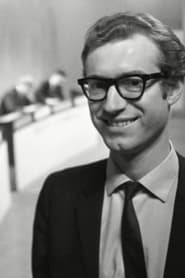 Bamber Gascoigneรับบท Self - Presenter
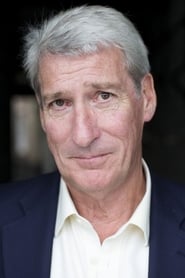 Jeremy Paxmanรับบท Self - Presenter
- Roger Tillingรับบท Self - Narrator
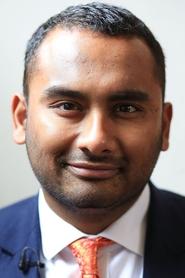 Amol Rajanรับบท Self - Presenter
- Eric Monkmanรับบท Self - Contestant
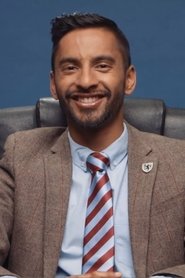 Bobby Seagullรับบท Self - Contestant
ซีซันและรายชื่อตอน
- University Challenge Season 161 ตอน · 21 กันยายน 2505
- University Challenge Season 262 ตอน · 3 ธันวาคม 2506
- University Challenge Season 342 ตอน · 25 สิงหาคม 2508
- University Challenge Season 440 ตอน · 7 กันยายน 2509
- University Challenge Season 544 ตอน · 27 กันยายน 2510
- University Challenge Season 645 ตอน · 2 สิงหาคม 2511
- University Challenge Season 747 ตอน · 20 กรกฎาคม 2512
- University Challenge Season 840 ตอน · 25 ตุลาคม 2513
- University Challenge Season 940 ตอน · 17 ตุลาคม 2514
- University Challenge Season 1039 ตอน · 25 ตุลาคม 2515
- University Challenge Season 1138 ตอน · 31 ตุลาคม 2516
- University Challenge Season 1235 ตอน · 2 ธันวาคม 2517
- University Challenge Season 1342 ตอน · 7 พฤศจิกายน 2518
- University Challenge Season 1436 ตอน · 17 ธันวาคม 2519
- University Challenge Season 1543 ตอน · 7 พฤศจิกายน 2520
- University Challenge Season 1641 ตอน · 27 พฤศจิกายน 2521
- University Challenge Season 1737 ตอน · 18 กุมภาพันธ์ 2523
- University Challenge Season 1840 ตอน · 15 ธันวาคม 2523
- University Challenge Season 1942 ตอน · 14 ธันวาคม 2524
- University Challenge Season 2039 ตอน · 30 มกราคม 2526
- University Challenge Season 2133 ตอน · 20 มกราคม 2527
- University Challenge Season 2239 ตอน · 7 เมษายน 2529
- University Challenge Season 2342 ตอน · 13 กรกฎาคม 2530
- University Challenge Season 2427 ตอน · 21 กันยายน 2537
- University Challenge Season 2527 ตอน · 1 พฤศจิกายน 2538
- University Challenge Season 2627 ตอน · 12 พฤศจิกายน 2539
- University Challenge Season 2727 ตอน · 10 กันยายน 2540
- University Challenge Season 2831 ตอน · 2 กันยายน 2541
- University Challenge Season 2931 ตอน · 13 กันยายน 2542
- University Challenge Season 3031 ตอน · 4 กันยายน 2543
- University Challenge Season 3131 ตอน · 23 กรกฎาคม 2544
- University Challenge Season 3231 ตอน · 2 กันยายน 2545
- University Challenge Season 3331 ตอน · 15 กันยายน 2546
- University Challenge Season 3431 ตอน · 13 กันยายน 2547
- University Challenge Season 3531 ตอน · 19 กันยายน 2548
- University Challenge Season 3631 ตอน · 7 สิงหาคม 2549
- University Challenge Season 3731 ตอน · 9 กรกฎาคม 2550
- University Challenge Season 3831 ตอน · 7 กรกฎาคม 2551
- University Challenge Season 3937 ตอน · 6 กรกฎาคม 2552
- University Challenge Season 4037 ตอน · 5 กรกฎาคม 2553
- University Challenge Season 4137 ตอน · 4 กรกฎาคม 2554
- University Challenge Season 4237 ตอน · 16 กรกฎาคม 2555
- University Challenge Season 4337 ตอน · 15 กรกฎาคม 2556
- University Challenge Season 4437 ตอน · 14 กรกฎาคม 2557
- University Challenge Season 4537 ตอน · 13 กรกฎาคม 2558
- University Challenge Season 4637 ตอน · 11 กรกฎาคม 2559
- University Challenge Season 4737 ตอน · 17 กรกฎาคม 2560
- University Challenge Season 4837 ตอน · 16 กรกฎาคม 2561
- University Challenge Season 4937 ตอน · 15 กรกฎาคม 2562
- University Challenge Season 5037 ตอน · 13 กรกฎาคม 2563
- University Challenge Season 5137 ตอน · 12 กรกฎาคม 2564
- University Challenge Season 5237 ตอน · 29 สิงหาคม 2565
- University Challenge Season 5337 ตอน · 17 กรกฎาคม 2566
- University Challenge Season 5437 ตอน · 12 สิงหาคม 2567
- University Challenge Season 5537 ตอน · 14 กรกฎาคม 2568
- University Challenge Season 5615 ตอน · 13 กรกฎาคม 2569
รีวิว University Challenge จากทีมงาน
เจาะลึก University Challenge: เนื้อเรื่อง การสร้าง และเสียงวิจารณ์
University Challenge is a British television quiz programme which first aired in 1962. University Challenge aired for 913 episodes on ITV from 21 September 1962 to 31 December 1987, presented by quizmaster Bamber Gascoigne. The BBC revived the programme on 21 September 1994, the programme's 32nd anniversary, with Jeremy Paxman as the quizmaster. Paxman relinquished his role as host following the conclusion of the 52nd series in 2023, and was succeeded by Amol Rajan.
The current title holders are the University of Manchester, who won a record equalling fifth title in the final of the 2025–26 series on 20 April 2026. On 21 April 2023, the BBC unveiled a new set and title card, which debuted on Rajan's first episode, aired on 17 July 2023.
The show has always been produced by the same company (originally named Granada Television, renamed ITV Studios in 2009 and renamed again Lifted Entertainment in 2021), under licence from Richard Reid Productions and the College Bowl Company. It was recorded at Granada Studios in Manchester from its inception until the studios closed in 2013; it is now recorded at Dock10 studios in Salford.
Format continuity
Despite periodic changes to the sets, studio layout, and presentation, University Challenge has preserved a high level of continuity from 1962 to the present. Some commentators have cited this as an essential element of its success. Elements of this continuity include:
The longevity of its quizmasters, with only three presenters in the programme's history;
The split-screen presentation during the starter question phase, which appears to place one team physically above the other. In the final years of the original Bamber Gascoigne era, the studio set genuinely was two-tiered, although the split-screen effect returned for the revived series and has been used ever since;
Long serving voiceover announcers, with only three in the programme's history – Don Murray-Henderson from 1962 until his death in 1971, then Jim Pope until his death in 2001, then Roger Tilling. Tilling's delivery typically becomes increasingly high-pitched as the episode progresses;
The theme tune "College Boy" by Derek New, which has been with the series since the 1960s (although the first series used "Ting A Ling" by Duke Ellington). "College Boy" was originally scored for an ensemble of tubular bells, flugelhorn, harpsichord, brushed hi-hat, bass drum and double bass. The original theme returned for the early Paxman-era episodes and was later replaced by a string quartet arrangement of the theme recorded by the Balanescu Quartet.
ITV (1962 to 1987)
The programme had its beginnings in an American television quiz show called College Bowl. Cecil Bernstein, brother of Sidney Bernstein who founded Granada Television in 1954, had seen the programme in the United States and liked the format. It was decided that Granada would produce a similar programme with competing teams from universities across the United Kingdom. From its inception in 1962, University Challenge was hosted by Bamber Gascoigne, who died in 2022. The programme's first match was a match between the University of Leeds (featuring a pre-fame Ian Channell, better known as The Wizard of New Zealand) and the University of Reading. The show was a cult favourite with a small but loyal core audience, and was one of a select few ITV programmes that was transmitted without any advertising breaks. Originally, the series started off in many areas, being broadcast at peak times or just after the nightly news around 22:30; by the early 1970s, the series was relegated to irregular timeslots by the various ITV regional companies, with some broadcasting the show during daytime, at weekends or late at night. In the absence of a regular networked slot, audience figures would often fall, leading the producers to make changes to the long-standing format of the programme. LWT stopped broadcasting the show in October 1983, with Thames following suit shortly afterwards. Thames resumed screening the series in 1984 however they only screened the Quarter-finals To the final in December 1984, when it was networked for the first time.
The programme was not broadcast in 1985 and returned in April 1986, when it continued to networked by ITV and broadcast at 15:00 on weekdays. The gameplay was revised, initial games were staged over two legs; the first in the classic format and the second played as a relay, where contestants selected questions from specific categories such as sport, literature and science, passing a baton between players whenever a "lap" of two correct answers was scored. The final series was also networked, but broadcast around 11:00 during the summer holiday period. Even so, the new networked time did little to save the series. The last ITV series was broadcast in 1987.
The Universities of Oxford and Cambridge could each enter up to five of their constituent colleges as separate teams, which are not themselves universities: they have far fewer students – numbering in the hundreds rather than thousands – than most universities. This was one ostensible inspiration for a 1975 protest, in which a team from the University of Manchester (which included David Aaronovitch) came second to Downing College, Cambridge, when they started a round by answering every question "Che Guevara", "Marx", "Trotsky" or "Lenin", in the hope of making the resulting show unbroadcastable.
It was, however, broadcast, although only portions of the episode still exist in the Granada Television archives. Granada subsequently banned the University of Manchester for several years.
BBC
University Challenge was revived by the BBC in 1994, although still produced by Granada Television (branded since 2009 as ITV Studios), using the original format, with minor differences, and presented by Jeremy Paxman.
During the show's hiatus, a special edition of the show was made by the BBC, as part of a themed evening of programmes dedicated to Granada Television. It was presented by Bamber Gascoigne and broadcast on BBC2 on 28 December 1992. The teams included one of students from Keble College, Oxford, which had fielded the winning team in the final 1987 season, and a graduates team of celebrity alumni who had previously appeared on the programme as students, including journalist John Simpson and actor Stephen Fry. This show was preceded by a short documentary about the show's history. Bamber Gascoigne's final appearance as host was in Universe Challenge in 1998 (see below).
Paxman relinquished his role as host following the conclusion of the 52nd series in 2023, after which he was succeeded by Amol Rajan. In October 2022, an ITV documentary, Paxman: Putting Up With Parkinson's, explored how Parkinson's disease has impacted him and revealed that Paxman recorded his last episode of University Challenge on 15 October 2022, which aired on 29 May 2023.
On 21 April 2023, the BBC unveiled a new set and title card, which debuted on Rajan's first episode, which aired on 17 July 2023.
Postgraduates
Since its revival in 1994, the programme has featured a number of teams of postgraduate and mature students, whose participation has been criticised. The Open University won the 1999 series with a team with an average age of 46. In the quarter-final, they narrowly beat a slightly younger team from part-time and mature student specialist Birkbeck, University of London. Birkbeck won the competition in 2003, also with a substantially mature team. Host Jeremy Paxman said that the Open University team was "not in the spirit" of the competition. The team publicly replied by challenging him to specify in what way this was "contrary to the spirit of the quiz – or of the university".
Ineligible contestants
In 2009, Sam Kay, part of the team from Corpus Christi College, Oxford, was accused of not being a student when the show was filmed. Kay, who had completed a chemistry degree the previous summer, had been planning to go on to study for a Doctor of Philosophy, but dropped out as he did not have sufficient funding. He then became an accountant. The team, whose captain Gail Trimble was dubbed the "human Google", won the competition but was subsequently disqualified and the trophy awarded to the runners-up, the University of Manchester.
A few days later, it was also revealed that Charles Markland, a member of the 2008 winning team from Christ Church, Oxford, had transferred his studies to Balliol College halfway through the series. He said that his team captain had contacted a researcher concerning the situation, and had been told that this was not a problem and that the same team should be maintained for continuity purposes. It was also revealed that Freya McClements, captain of the 2004 winning team from Magdalen College, Oxford, was at the time studying at Trinity College, Dublin. Although it was mentioned in a BBC news story at the time, no action was taken because the BBC stated that the facts had not been brought to their attention.
Editing
In 2016, at the Henley Literary Festival, Jeremy Paxman said that, when students were unable to answer several consecutive starter questions, those questions were often deleted before the show is broadcast.
In popular culture
In an episode of the BBC comedy series Not the Nine O'Clock News, first broadcast on 15 December 1980, Griff Rhys Jones plays Bamber Gascoigne in a sketch that pitches two teams of criminals representing prisoners from Wormwood Scrubs and Parkhurst. The teams score "points" (remission of sentence) by "grassing" on possible suspects involved in a crime.
In 1984 an episode of The Young Ones, entitled "Bambi" (a play on Bamber Gascoigne's name), centred on a parody of University Challenge with a match between the fictitious teams of Scumbag College and Footlights College, Oxbridge. The cast included Stephen Fry, who participated in the real competition in 1980 while at Cambridge, and fellow alumni and Footlights members Emma Thompson and Hugh Laurie as part of the "Footlights College" team, and Griff Rhys Jones as the host. The teams are arranged physically one above the other, in a parody of the show's split-screen format.
A quiz themed around BBC science fiction situation comedy Red Dwarf, broadcast in 1998, is entitled Universe Challenge. It opens as if it were a regular episode, but with Chris Barrie impersonating Jeremy Paxman. Gascoigne comes from behind with a blaster gun and blows him out of the chair to take over as host. This was Gascoigne's last appearance as host.
In a list of the 100 Greatest British Television Programmes drawn up by the British Film Institute in 2000, voted for by industry professionals, University Challenge was placed 34th.
Starter For Ten is the title of a novel, first published in 2003, by British author David Nicholls. The plot is about a first-year student, Brian Jackson, who attempts to join his university team competing in University Challenge. Nicholls also adapted the novel into the film Starter for 10 in 2006, starring James McAvoy as Jackson, with Mark Gatiss portraying Gascoigne.
In 2006 Armando Ianucci's Time Trumpet presented a parody of University Challenge, set in a future where students are 'too lazy to learn'; this parody was later referenced in an episode of the 2007–08 series of University Challenge by the team captain of SOAS, Joe Perry, who, not knowing the real answer, simply answered "Venezuela?"
The quiz was the subject of the hour-long BBC Two documentary The Story So Far, first broadcast in November 2006.
In 2014, a two-part documentary narrated by Richard Osman called 'Class of 2014' outlined a brief history of the programme and the team selection process both within the universities and by the production staff. The documentary attracted some criticism due to the large emphasis on Oxbridge and Manchester during the programme.
In March 2017 semi-finalist team captains Bobby Seagull of Emmanuel College, Cambridge, and Eric Monkman of Wolfson College, Cambridge, appeared on BBC One's The One Show. In August 2017 the two were featured on BBC Radio 4's Today programme ahead of hosting their own show, Monkman and Seagull's Polymathic Adventure, on 21 August.
In 2024, Amol Rajan's reply "We need jungle, I’m afraid" was widely sampled by music producers, becoming a viral phenomenon.
Teams
Teams consist of four members and most represent a single university. The exceptions to this are colleges of the University of Oxford, the University of Cambridge, the University of London and formerly the University of Wales which enter independent teams. While a number of other British universities have constituent colleges, only those where some teaching is undertaken at the college level may enter independent teams. The competing teams each year are selected by the show's producers, based both on scores from a general trivia quiz and the producers' judging of the suitability of the teams for television. Oxford and Cambridge ("Oxbridge") colleges are prevalent in the competition: for instance, of the Christmas series between 2011 and 2022, Oxbridge colleges represented one-quarter of teams and three-quarters of winners.
The contestants are identified by their surnames during gameplay, apart from at the beginning when they introduce themselves with their full names, where they are from and what they are studying.
The teams generally consist of mixed genders, mostly young adults but with some mature students also appearing.
Tournament structure
The current tournament format used for each series is that of a direct knockout tournament starting with 28 teams. The fourteen first-round winners progress directly to the last sixteen. Two repechage matches, involving the four highest scoring losing teams from the first round, whose losing scores often exceed winning scores in other first-round matches, fill the remaining places in the last sixteen. Teams in the quarter-final round (last eight teams) have to win two matches in the round to progress to the semi-finals. Equally, teams must lose two quarter-final matches in order to be eliminated from that round. The pairings for matches are often chosen in order to keep stronger teams apart.
Question format
Each round begins with a starter question, which is worth ten points. The catchphrase "your starter for ten" inspired David Nicholls' 2003 novel Starter for Ten and the 2006 film based on it starring James McAvoy. Starter questions must be answered by individual contestants without conferring with their team. Only one contestant from each team may attempt to answer, and the first team to answer correctly receives the points. Contestants may interrupt the quizmaster with their answer, but if they are incorrect, they will incur a five-point penalty. During the ITV series this took the form of five points being awarded to the opposing team, whereas in the BBC series five points are deducted from the interrupting team.
The team answering a starter correctly gets a set of bonus questions worth a potential fifteen points, and they may confer before answering. Answers to bonus questions are given by the team captain, unless the captain nominates another team member using the phrase, "Nominate [name];" in that case, the named team member answers instead. The bonus questions in a set are thematically linked with each other, but they rarely share a connection with the preceding starter question except when they are bonuses following a picture or music question. Generally, there are three separate bonus questions worth five points each, but occasionally a bonus will require the enumeration of a given list with five, ten or fifteen points given for correctly giving a certain number of items from the list (for example, "there are seven fundamental SI units. Give five for five points, six for ten points or all seven for fifteen points").
In the course of a game there are two picture rounds, occurring roughly one quarter and three-quarters of the way through, and one music round occurring roughly at the half-way point. The bonus questions in a picture or music round are thematically connected to the starter question, though if neither team correctly answers the starter, the accompanying bonuses are held back and used after a normal starter is correctly answered. Usually, in the recent contests, the first picture round focuses on science and technology, geography, and languages, while the second picture round focuses on art, film, television, and literature. Pieces of music played for the music round may be classical or popular – for example, on 25 July 2011, the pieces played were winners of the Eurovision Song Contest. Occasionally, audio clips other than music (e.g. speech, animal sounds or other field recordings) are used. The 2010 Manchester University team included a visually impaired student, Rachael Neiman, and the picture rounds in episodes involving the team were word puzzles for which she was provided with Braille transcriptions. In the 7th episode of the 2024 Christmas series, three audio rounds replaced the usual picture rounds to accommodate two visually impaired participants, Jamie MacDonald and Halima Begum. These audio rounds included identifying bird songs, depictions of snow in classical music and songs featured on the 1974 Pazz & Jop list.
The pace of questioning gradually increases through the show. The sound of a gong signals the end of the game. At this point, the game immediately ends, even if the quizmaster is halfway through asking a question. In the event of a tied score at the sound of the gong, a sudden death question is asked, the first team to answer correctly being deemed the winner; this is repeated until a team either gives a correct answer to a question or is deducted five points for an incorrect interruption to a question. The ending of the programme is usually signified with the quizmaster saying, "It's goodbye from ([name of losing team], who say goodbye), it's goodbye from ([name of winning team], likewise), and it's goodbye from me: goodbye!" Afterwards, during the closing credits Rajan sometimes walks over and confers with the losing team.
Production
While the starter questions are being read out, the teams are shown on screen one above the other by means of a split-screen effect. When a player buzzes in, the shot zooms in to that player, accompanied by a voiceover identifying the player by team and surname, for example "Nottingham, Munro". The voiceovers are performed live in the studio by Roger Tilling and become more energetic towards the end of the programme. The 1986 series experimented with an actual two-tier set, which was discontinued the following year.
Notable contestants
Notable contestants in this section refers to the regular student competition; Special Celebrity Christmas editions, where all competitors are distinguished, are excluded.
Entertainers
Stephen Fry – Queens' College, Cambridge, 1980
Clive James – Pembroke College, Cambridge, 1968
Miriam Margolyes – Newnham College, Cambridge, 1963
John Sessions – reserve for UCNW Bangor, 1973
June Tabor – St Hugh's College, Oxford, 1968
The Wizard of New Zealand (Ian Brackenbury Channell) – University of Leeds, 1963
Authors
Sebastian Faulks – Emmanuel College, Cambridge, 1972
Julian Fellowes – Magdalene College, Cambridge, 1969
David Starkey – Fitzwilliam College, Cambridge
Politicians
Aaron Bell – St John's College, Oxford, 2001
Tim Boswell – New College, Oxford
Damian Collins – St Benet's Hall, Oxford, 1995
Kwasi Kwarteng – Trinity College, Cambridge, 1995
David Lidington – Sidney Sussex College, Cambridge, 1978
David Mellor – Christ's College, Cambridge
Malcolm Rifkind – University of Edinburgh, 1967
Mary Robinson – Trinity College Dublin, 1966
Journalists
David Aaronovitch – Victoria University of Manchester, 1975
John Authers – University College, Oxford, 1987
Christopher Hitchens – Balliol College, Oxford, 1968
Charles Moore – Trinity College, Cambridge, 1978
John Simpson – Magdalene College, Cambridge, 1964
Josh Spero – Magdalen College, Oxford, 2004
Jim Waterson – Jesus College, Oxford, 2010
Others
Brandon Blackwell (Quizzer / TV personality) – Imperial College London, 2020
Daisy Christodoulou (Teacher / Education campaigner) – University of Warwick, 2007
Patrick Finglass (Academic) – St John's College, Oxford, 2001
Sarah Healey (Civil Servant) – Magdalen College, Oxford, 1998
Mark Labbett (Quizzer / TV personality) – University of Glamorgan, 1997
Eric Monkman (Academic / TV presenter) – Wolfson College, Cambridge, 2017
Mark Pallen (Academic) – Imperial College London, 1996
Jenny Ryan (Quizzer / TV personality) – University of Leeds, 2003
Bobby Seagull (Teacher / TV presenter) – Emmanuel College, Cambridge, 2017
Dorjana Širola (Quizzer) – Somerville College, Oxford, 2002
Michael Taylor (Historian) – Gonville and Caius College, Cambridge, 2015
Gail Trimble (Academic) – Corpus Christi College, Oxford, 2009
Winners
Imperial College London and the University of Manchester hold the record for most wins, with five each (though Manchester's 2009 win came only after the original winners were disqualified). Magdalen College, Oxford are third with four wins; they and Manchester are the only teams to successfully defend the title. Trinity College, Cambridge and Durham University hold three titles, and a further six institutions have two titles: the University of Sussex, the Open University, Sidney Sussex College, Cambridge, Keble College, Oxford, University College, Oxford and the University of Warwick. At the time of Magdalen College, Oxford's third win in 2004, no other institution had won more than twice; the trophy in use since 1994 was given to the college in perpetuity and a new one was created for use from 2005.
Most series wins
Information in these tables obtained from Blanchflower – University Challenge Series Champions.
เนื้อหาส่วนนี้มาจากบทความ "University Challenge" ในวิกิพีเดีย (en.wikipedia.org) เผยแพร่ภายใต้สัญญาอนุญาตครีเอทีฟคอมมอนส์ แสดงที่มา-อนุญาตแบบเดียวกัน 4.0 (creativecommons.org/licenses/by-sa/4.0) มีการตัดส่วนอ้างอิงและจัดรูปแบบใหม่
คำถามที่พบบ่อยเกี่ยวกับ University Challenge
University Challenge มีกี่ตอน?
University Challenge มีทั้งหมด 2058 ตอน รวม 56 ซีซัน สถานะปัจจุบัน: ยังฉายอยู่
University Challenge ฉายวันไหน?
University Challenge เริ่มออกอากาศครั้งแรกวันที่ 21 กันยายน 2505 ตอนถัดไปออกอากาศวันที่ 12 ตุลาคม 2569
University Challenge ดูได้ที่ไหน?
ขณะนี้ยังไม่พบแพลตฟอร์มที่มีลิขสิทธิ์ University Challenge ในประเทศไทย
หมวดแนะนำ: ซีรี่ย์จีนพากย์ไทย · เรื่องถัดไป: The Challenge: All Stars
ซีรี่ย์ที่คล้ายกับ University Challenge
 จบแล้ว 1062 ตอน★ 6.3
Who Wants to Be a Millionaire? (1999)
 จบแล้ว 239 ตอน★ 7.2
8 Out of 10 Cats (2005)
 จบแล้ว 3777 ตอน★ 7.6
The Tonight Show Starring Johnny Carson (1962)
 จบแล้ว 947 ตอน★ 6.2
The Kelly Clarkson Show (2019)
 จบแล้ว 470 ตอน★ 6.8
The Dick Cavett Show (1968)
 จบแล้ว 76 ตอน★ 6.7
StarTalk with Neil deGrasse Tyson สตาร์ ทอร์ค กับ นีล เดอกราส ไทสัน (2015)
 จบแล้ว 230 ตอน★ 7.2
Talking Dead (2011)
 EP1/1★ 8.8
Kids' Choice Awards (1987)
 EP50/49★ 6.0
At the Movies (1986)
 ★ 7.8
★ 7.8MTV Video Music Awards (1984)
 จบแล้ว 2 ตอน★ 8.1
Crisis Aftermath (2019)
 จบแล้ว 3 ตอน★ 8.9