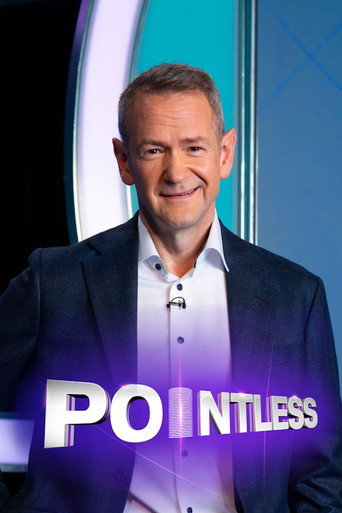
Pointless (2009)
รายการวาไรตี้ซีรี่ย์ 2009เรียลลิตี้
- ชื่อภาษาอังกฤษ
- Pointless
- ประเทศ
- สหราชอาณาจักร
- ออกอากาศครั้งแรก
- 24 สิงหาคม 2552
- จำนวนตอน
- 1907 ตอน (36 ซีซัน)
- ความยาวต่อตอน
- ประมาณ 43 นาที
- สถานะ
- ยังฉายอยู่
- ตอนล่าสุด
- EP15/15 (8 ตุลาคม 2569)
- ช่อง/แพลตฟอร์มต้นทาง
- BBC One, BBC Two
- เรตผู้ชม
- NR
- คะแนน TMDB
- 6.5/10 (44 โหวต)
เรื่องย่อ Pointless
Pointless เป็นรายการวาไรตี้ ปี 2009 มีทั้งหมด 1907 ตอน สถานะยังฉายอยู่
ยังไม่มีเรื่องย่อภาษาไทย แสดงเรื่องย่อต้นฉบับภาษาอังกฤษ
Quiz in which contestants try to score as few points as possible by plumbing the depths of their general knowledge to come up with the answers no-one else can think of.
Pointless ดูได้ที่ไหน (ถูกลิขสิทธิ์)
ยังไม่พบข้อมูลผู้ให้บริการที่มีลิขสิทธิ์เรื่องนี้ในประเทศไทย ต้นทางออกอากาศทาง BBC One, BBC Two เราจะอัปเดตทันทีเมื่อมีแพลตฟอร์มนำเข้ามาฉาย
นักแสดง Pointless
 Alexander Armstrongรับบท Self - Presenter
 Richard Osmanรับบท Self - Assistant
 Ria Linaรับบท Self - Assistant
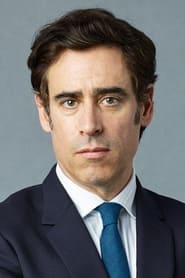 Stephen Manganรับบท Self - Assistant
 Anita Raniรับบท Self - Presenter
 Nish Kumarรับบท Self - Presenter
 Lucy Porterรับบท Self - Assistant
 Angela Scanlonรับบท Self - Presenter
 Gok Wanรับบท Self - Presenter
 Susan Wokomaรับบท Self - Presenter
 Michael Ballรับบท Self - Presenter
 Lauren Laverneรับบท Self - Assistant
ซีซันและรายชื่อตอน
- Pointless Season 130 ตอน · 24 สิงหาคม 2552
- Pointless Season 230 ตอน · 8 มีนาคม 2553
- Pointless Season 350 ตอน · 30 สิงหาคม 2553
- Pointless Season 460 ตอน · 14 มีนาคม 2554
- Pointless Season 560 ตอน · 29 สิงหาคม 2554
- Pointless Season 670 ตอน · 13 กุมภาพันธ์ 2555
- Pointless Season 770 ตอน · 29 สิงหาคม 2555
- Pointless Season 865 ตอน · 2 มกราคม 2555
- Pointless Season 955 ตอน · 3 เมษายน 2556
- Pointless Season 1069 ตอน · 26 กันยายน 2556
- Pointless Season 1155 ตอน · 20 มีนาคม 2557
- Pointless Season 1255 ตอน · 28 ตุลาคม 2557
- Pointless Season 1351 ตอน · 23 มีนาคม 2558
- Pointless Season 1455 ตอน · 29 กรกฎาคม 2558
- Pointless Season 1555 ตอน · 1 มีนาคม 2559
- Pointless Season 1655 ตอน · 24 ตุลาคม 2559
- Pointless Season 1755 ตอน · 19 เมษายน 2560
- Pointless Season 1855 ตอน · 2 ตุลาคม 2560
- Pointless Season 1955 ตอน · 2 เมษายน 2561
- Pointless Season 2055 ตอน · 19 มิถุนายน 2561
- Pointless Season 2155 ตอน · 28 มกราคม 2562
- Pointless Season 2255 ตอน · 2 กันยายน 2562
- Pointless Season 2355 ตอน · 7 เมษายน 2563
- Pointless Season 2455 ตอน · 7 ตุลาคม 2563
- Pointless Season 2555 ตอน · 6 เมษายน 2564
- Pointless Season 2655 ตอน · 21 กรกฎาคม 2564
- Pointless Season 2755 ตอน · 15 มีนาคม 2565
- Pointless Season 2855 ตอน · 20 กันยายน 2565
- Pointless Season 2954 ตอน · 3 เมษายน 2566
- Pointless Season 3055 ตอน · 31 สิงหาคม 2566
- Pointless Season 3148 ตอน · 3 เมษายน 2567
- Pointless Season 3249 ตอน · 29 สิงหาคม 2567
- Pointless Season 3348 ตอน · 5 กุมภาพันธ์ 2568
- Pointless Season 3446 ตอน · 22 กันยายน 2568
- Pointless Season 3547 ตอน · 8 เมษายน 2569
- Pointless Season 3615 ตอน · 18 กันยายน 2569
รีวิว Pointless จากทีมงาน
เจาะลึก Pointless: เนื้อเรื่อง การสร้าง และเสียงวิจารณ์
Pointless is a British television quiz show produced by Banijay UK Productions subsidiary Remarkable Entertainment for the BBC and hosted by Alexander Armstrong. In each episode, four teams of two contestants attempt to find correct but obscure answers to four rounds of general knowledge questions, with the winning team eligible to compete for the show's cash jackpot.
Pointless debuted on BBC Two on 24 August 2009. The success of the first three series led the BBC to move it to BBC One from 2011. As of September 2026, the programme is airing Series 36 and has had peak audience figures of over 7 million viewers. An offshoot of the show entitled Pointless Celebrities aired between 2011 and 2025 and aired for 17 series. The format has been exported internationally.
The first 27 series were co-presented by Richard Osman, who announced on 8 April 2022 that he would step down from the role to focus more on his writing career. Beginning with Series 28, a group of guests took his place. Osman continued to co-present with Armstrong on Pointless Celebrities.
Development
The show was originally to be called Obviously and was conceived by Tom Blakeson, Simon Craig, David Flynn, Nick Mather, Richard Osman and Shaun Parry, producers at Endemol UK, in 2009. They envisaged it as a "reverse Family Fortunes ... rewarding obscure knowledge, while allowing people to also give obvious answers ... a quiz which could be sort of highbrow and populist simultaneously".
Osman was not intended to be co-presenter; originally, he filled the role only as part of a demonstration laid on for the BBC. BBC executives asked him to continue when they commissioned the first series. Osman then approached comedian Alexander Armstrong to be the main presenter; the two men had been peers during their university days. Armstrong, who the previous year had been lined up to present Channel 4's Countdown only to back out for fear of being pigeonholed as a presenter, agreed to present what was perceived as a lower-profile show, with the presence of Osman helping to convince him.
In 2016, Osman told the Belfast Telegraph that "It's never been a show that's had posters, or trailers, and it's presented by these two slightly inept guys. Everyone who's ever watched it feels like it's their programme. We've never changed it, but have always done it in the same way, which is slightly shoddy, enjoying ourselves." On the programme's future, he said, "Every programme has a shelf-life, but as long as people are enjoying it, we will stick with it. If Channel 4 wanted to offer three times as much money, we wouldn't take it. We would stay with the BBC. We love the BBC. Pointless is not for sale. We owe the BBC an enormous debt, because they've looked after us."
After Series 27, Osman retired from the regular series (remaining as co-presenter on Pointless Celebrities) and for series 28 was replaced by presenters: Sally Lindsay, Stephen Mangan, Lauren Laverne, Konnie Huq and Alex Brooker. Series 29 added Ed Gamble, Rose Matafeo, Ria Lina, Lucy Porter and Gyles Brandreth. Series 30 added Nish Kumar, Andi Oliver, Sally Phillips and Vick Hope. Series 31 added Hugh Dennis, Anita Rani, Gabby Logan, Josh Widdicombe and Desiree Burch. Series 32 added Chris Ramsey, Gok Wan, Rob Rinder, and Ellie Taylor. Series 33 added Liza Tarbuck, Phil Wang and Mel Giedroyc. Series 34 added Angela Rippon, Trevor Nelson, Judi Love, Gethin Jones, and Tom Allen. Series 35 added Angela Scanlon, Susan Wokoma, and saw the return of Gok Wan, Nish Kumar, and Lucy Porter. Series 36 added Michael Ball, Ben Miller, Sara Pascoe, and Clare Balding.
Gameplay
Teams of two contestants attempt to provide answers that are not only correct, but also as obscure as possible. The programme initially featured five teams per episode, but the field was later reduced to four. On each episode, contestants answer a series of questions that were put to 100 members of the general public in a previously conducted online survey, which had a time limit of 100 seconds. Once a question is asked at the start of a round, the contestants are given details as to what constitutes a valid answer. If a team's answer is correct, they score one point for each participant who gave it during the survey; an answer given by none of the participants is termed "pointless" and adds nothing to the team's score. Incorrect answers score the maximum of 100 points. Once a question or pass is complete, depending on the specific format of the round, the lowest- and highest-scoring answers given in the survey are stated, usually the top three.
The game begins with two Elimination Rounds, in which teams must achieve as low a score as possible. The rounds are scored independently of one another, and the team with the highest score in each round is eliminated from the game. The two surviving teams compete against each other in the "Head-to-Head" to find low-scoring answers; the first team to win two questions moves on to the Final to play for the jackpot.
Teams may return to the programme until they have either reached the Final once or been eliminated in three (two prior to series 25) consecutive episodes, whichever occurs first.
The jackpot increases by £250 for every pointless answer given in any round other than the Final. If a team reaches the Final but fails to win the jackpot, it is rolled over to the next episode and increased by £1,000. As of May 2022 the highest recorded jackpot won on the show was £24,750 on 8 March 2013. Once the jackpot is won, the amount is reset to £1,000.
Contestants who are deaf or hard of hearing are allowed the use of an interpreter, who may translate between spoken words and sign language as needed. The interpreter may not suggest answers or take any other active role in the game.
Elimination Rounds
During an Elimination Round, teams aim to score as few points as possible. Each round consists of a question derived from a subject with each member of a team required to give an answer during a pass; each round consists of two passes and teams must decide who will play which pass before the question is asked. Teammates may not confer on answers during the round. Order of play for the first pass is determined by random draw in Round 1 and by ascending order of first-round scores in Round 2. For the second pass in each round, the order of play is reversed.
After both passes are complete, the team with the highest score for the round is eliminated from the game. In the event of a tie for high score, the affected teams are allowed to confer and offer one more answer to the question as a tiebreaker; the order of answers given is identical to the first pass. If the scores remain tied after this pass, the question is thrown out and a new one is played.
Six different formats for the questions have been used during the programme's run for the elimination rounds in each game:
Open-Ended – Contestants are given the question and have free choice of what answer to give. A modified version of this format is sometimes used in which the contestants must name items that belong to any of several sub-categories (e.g. given a list of acronyms, choose one and state the word represented by any one of its letters).
Possible Answers – Introduced in Series 2, contestants are given a board of potential answers to a question and must each pick one, attempting to find the obscure ones on the board and avoid picking out a wrong answer. Each pass consists of two boards, each possessing at least one pointless answer and at least one incorrect answer, the latter usually having some indirect link (often humorous) with the question. This format allowed categories to be used in which no commonly agreed definitive list of correct answers might exist. It was discontinued following the end of Series 5.
Clues and Answers – Introduced in Series 3, contestants are given a list of clues related to the topic of the question, whereupon they must select a clue and provide the correct answer connected to it. An example of this format is that a list could contain the names of different battles and the question requires a contestant to name the country in which it occurred (e.g., "the Battle of Hastings" – "England"). Although the round follows a similar style to that of the "Possible Answers" format, there is no guarantee that contestants may find a pointless answer from within the list. If a team answers incorrectly, that clue remains in play and can be chosen again. The number of clue/answer pairs is always three more than the number of teams playing a round, and a new board is used on each pass.
Linked Categories – Introduced in Series 5, each pass consists of two closely related categories; one team member provides an answer related to the first category while the other provides an answer to the second category. The format follows the same principles as that of the "Open-ended" format, but was rarely used and was later discontinued after the series.
Picture Board – Introduced in Series 7, contestants are shown a grid of pictures or items and must identify one at a time. In some cases, the pictures have some of the letters in their correct answers filled in and/or serve as clues to items that must be named. Depending on the rules of the particular board, contestants might have to state which picture they are identifying.
Part Identification – Introduced in Series 24, contestants are shown seven items and four groups into which they must be sorted (e.g. given a list of seven parts of the human head, decide whether each is found in the brain, ear, eye, or mouth). Each contestant selects one item and must identify the group to which it belongs. As in "Clues and Answers," a new board is played on each pass, and an incorrect guess leaves that item available to opponents.
As of Series 25, the most common format for the elimination rounds involves "Clues and Answers" for one and either "Open-Ended" or "Picture Board" for the other. For all formats except "Open-Ended" and "Picture Board", the last contestant or team to play on a particular board is invited to answer as many remaining items as they wish before selecting one to use on that turn.
Head-to-Head
The two remaining teams compete against each other, answering questions with the intention of finding the lowest scores possible. Both teams can now confer and the winning team of this round moves on to the Final. The format of this round has differed, as listed below:
Series 1 – The teams take turns providing one answer to a question at a time and attempting to score as few points as possible. The lower-scoring team from the elimination rounds chooses one of two categories to be played. Each team is given an equal number of turns; if at least one team has exceeded 100 at the end of a pass, the round ends and the lower-scoring team wins.
Series 2 to 5 – Both teams compete in a multi-question best-of contest; best-of-five in Series 2 and best-of-three from Series 3. Each team must give an answer to a question and once both have done so, the lower score of the two wins the question and earns that team a point. Each question will usually have a minimum of four answers to choose from and the order of play is that the team who acquired the fewest points in the elimination rounds gets to answer first on the first question.
As of Series 6 – Both teams compete in a multi-question best-of-three contest; while the format is the same since Series 3, all questions have five answers with each team choosing one. Questions follow one of three formats: Picture Board (occasionally using sound cues or with some letters of the correct answer filled in); Clues and Answers; or answers that have been scrambled/anagrammed or had some of their letters removed. Both teams may choose the same item if the second team to play believes that the first has answered incorrectly. The second team is invited to fill in as many missing answers as they can before choosing one.
Midway through Series 23, a new round was added to give the contestants more opportunities to increase the jackpot. It is played between the second elimination round and the head-to-head and is similar to the previously retired "Possible Answers" format. The contestants are shown a question and six possible answers - two of which are pointless while two are incorrect, often with a tangential or humorous link to the question. Each pair may offer one answer with no risk of elimination and all four contestants may confer with one another if desired. Any chosen pointless answers add £250 to the jackpot.
Final
The last remaining team receives a pair of trophies to keep regardless of what happens in the Final and now attempts to win the game's jackpot. The team chooses one category from a list, whereupon the host reads a series of questions associated with it that have multiple correct answers (e.g. characters in the play King Lear or films starring Emily Watson). The contestants may take up to 60 seconds to discuss the questions, after which they must jointly give three answers. If any individual answer is pointless, the team wins the jackpot; otherwise it rolls over to the next episode.
Originally, contestants could choose from one of three categories, with unused ones remaining in the list for five days or until they were selected, and had to provide answers to a single question within the chosen category. This format was used between Series 1 and Series 5. The number of available categories was increased to five at the start of Series 6, then reduced to four in Series 9. By the start of the second half of Series 9, the round was modified to require the contestants to provide answers to any or all of three questions connected to their chosen category. They must specify which question they are attempting with each of their three answers and can only win the jackpot if any answer is pointless for its nominated question. As of Series 29, the contestants are presented with two questions in their chosen category and can win an additional £500 by giving three pointless answers.
Pointless Celebrities
Following the success of Pointless and its transfer to BBC One, the BBC commissioned a celebrity edition of the programme, entitled Pointless Celebrities. Much like the main show, Pointless Celebrities has teams of two celebrities competing against each other to win the jackpot for their chosen charities and has the same gameplay as the regular show.
Unlike the regular version, the jackpot does not roll over and always starts at £2,500 with every pointless answer adding £250 to the jackpot, but this may be doubled on some occasions. £500 is donated to every team who do not win the jackpot and any money won by a team is split equally between the two charities represented by its members.
Pointless Celebrities was broadcast within a prime-time slot on Saturday nights and featured some differences in how the game worked. Celebrities were allowed to return in more than one episode with the same partner or a different partner and episodes tended to have a theme in regards to the celebrity contestants that took part – for example, a celebrity edition aired in December 2015 consisted of celebrities who were made famous on reality television shows like Big Brother and Made in Chelsea. Some editions of the show end with a guest performance.
Pointless Celebrities was axed in 2022, at the same time as Osman had announced he was ceasing his involvement in the show. However, the news confirming the show would not be renewed was only revealed after a four-year backlog of episodes had been exhausted, this news being revealed on 28 May 2026.
Co-hosts
Up to series 36 episode 15 on 8 October 2026.
Broadcast and ratings
Series 1 aired on BBC Two between August and October 2009 with the corporation announcing on the day of the final episode's broadcast that it had commissioned Series 2. The series' audience had peaked at 1.69 million viewers; 17.2% of audience share for the timeslot, while averaging around 1 million viewers per episode. Series 2 saw audiences grow modestly; the format was tweaked prior to the start of Series 3, reducing the number of rounds and giving more time for banter between the hosts which had previously been edited out. The change saw strong viewer growth and the show was moved to the BBC's main channel BBC One in 2011. By 2013, the programme was recording four episodes in one day and averaged 3.6 million viewers daily, gaining more viewers than ITV game show The Chase, which airs in roughly the same time slot.
In February 2014, Pointless was extended for another 204 episodes, giving three more series, taking the total commissioned to 13 in February 2014. A further 24 celebrity specials were also ordered. For the 1,000th episode, Alexander Armstrong and Richard Osman traded host and assistant duties and four previous couples who had distinguished themselves in various ways were invited to compete again. The jackpot for this episode began at £2,500 (the usual starting value for Pointless Celebrities) and every pointless answer during the main game added £1,000 to it. On 23 February 2016, it was announced that the show had been recommissioned by the BBC to make 165 more Regular daytime editions along with 45 prime-time Celebrity Specials taking Pointless to the end of 2017. On 4 September 2017, it was announced that the BBC had commissioned a further 204 episodes including 165 regular and 39 celebrity specials.
With the start of Series 11 of Pointless Celebrities, the show's set design was changed with some new graphics and an updated intro replaced the one used since the show's debut; this extended to Series 19 of Regular Pointless.
International broadcast
In Australia, Pointless has aired on both BBC UKTV (series 10 and 11) and ABC (series 9–11).
As of 28 May 2025, it is aired on the Nine Network at 2pm on weekdays.
In South Africa, Pointless airs on BBC BRIT on the African satellite television provider, DStv.
International versions
Legend: Currently airing No longer airing
An American version was set to be developed by GSN in 2017. A pilot episode presented by Alison Sweeney with Doug Mirabello as her assistant was produced by Endemol Shine America but never aired.
App games
On 26 February 2014, Endemol's in-house app-publishing division released the official Pointless app, Pointless Quiz, was released for iOS, with an iPad, Android and an Amazon version released a few months later. The Pointless app features animated versions of Alexander Armstrong and Richard Osman, and allows the player to tackle questions in a similar format to the TV show.
In October 2018, Vocala released an Amazon Alexa Skill based on the show.
Books
Five books have been released of the show: The 100 Most Pointless Things in the World, The 100 Most Pointless Arguments in the World, The Very Pointless Quiz Book (not to be mistaken for The Pointless Book), The A-Z of Pointless: A brain-teasing bumper book of questions and trivia and A Pointless History of the World. All five were released by Coronet. In the books, Armstrong and Osman give their insight into pointless matters.
Board games
Three editions of the official board game have been published by University Games, as well as two mini-sized versions, each of which contains updated questions.
In popular culture
Pointless appeared in the BBC sitcom Not Going Out (Series 7, Episode 5); Armstrong and Osman both played themselves. Pointless was also parodied in several sketches of the satirical show Newzoids, in which a caricature of Osman interrupts people in regular situations with phrases used in the game show.
เนื้อหาส่วนนี้มาจากบทความ "Pointless" ในวิกิพีเดีย (en.wikipedia.org) เผยแพร่ภายใต้สัญญาอนุญาตครีเอทีฟคอมมอนส์ แสดงที่มา-อนุญาตแบบเดียวกัน 4.0 (creativecommons.org/licenses/by-sa/4.0) มีการตัดส่วนอ้างอิงและจัดรูปแบบใหม่
คำถามที่พบบ่อยเกี่ยวกับ Pointless
Pointless มีกี่ตอน?
Pointless มีทั้งหมด 1907 ตอน รวม 36 ซีซัน สถานะปัจจุบัน: ยังฉายอยู่
Pointless ฉายวันไหน?
Pointless เริ่มออกอากาศครั้งแรกวันที่ 24 สิงหาคม 2552
Pointless ดูได้ที่ไหน?
ขณะนี้ยังไม่พบแพลตฟอร์มที่มีลิขสิทธิ์ Pointless ในประเทศไทย
หมวดแนะนำ: เว็บซีรี่ย์ · เรื่องถัดไป: The Contender
ซีรี่ย์ที่คล้ายกับ Pointless
 ★ 7.4
★ 7.4Beast Games บีสต์เกมส์ (2024)
 EP15/21★ 6.3
The Price Is Right (1972)
 EP20/20★ 6.9
Jeopardy! (1984)
 EP9/9★ 6.5
Squid Game: The Challenge สควิดเกม เดอะ ชาเลนจ์ (2023)
 ★ 6.9
★ 6.9Wheel of Fortune (1983)
 ★ 7.2
★ 7.2The Challenge (1998)
 จบแล้ว 69 ตอน★ 6.1
Total Wipeout (2009)
 EP14/14★ 5.8
Guy's Grocery Games (2013)
 EP12/12★ 7.5
The Masked Singer (2019)
 ★ 6.9
★ 6.9The Mole เดอะ โมล (2022)
 ★ 7.7
★ 7.7Celebrity Family Feud (2015)
 EP8/8★ 6.5