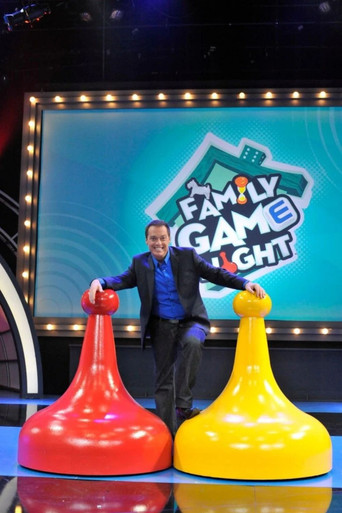
Family Game Night (2010)
ซีรี่ย์ฝรั่งซีรี่ย์ 2010ครอบครัว
- ชื่อภาษาอังกฤษ
- Family Game Night
- ประเทศ
- สหรัฐอเมริกา
- ออกอากาศครั้งแรก
- 10 ตุลาคม 2553
- จำนวนตอน
- 102 ตอน (5 ซีซัน)
- ความยาวต่อตอน
- ประมาณ 44 นาที
- สถานะ
- จบแล้ว
- ตอนล่าสุด
- EP15/16 (16 พฤศจิกายน 2557)
- ช่อง/แพลตฟอร์มต้นทาง
- Hub Network
- เรตผู้ชม
- TV-G
เรื่องย่อ Family Game Night
Family Game Night เป็นซีรี่ย์ฝรั่ง ปี 2010 มีทั้งหมด 102 ตอน สถานะจบแล้ว
ยังไม่มีเรื่องย่อภาษาไทย แสดงเรื่องย่อต้นฉบับภาษาอังกฤษ
Family Game Night is a television series based on Hasbro's family of board games and EA's video game franchise of the same name. The show is hosted by Todd Newton. Burton Richardson announced for the first two seasons, until he was replaced by Stacey J. Aswad for the third season, and then Andrew Kishino beginning in the fourth season. The 60-minute program debuted on October 10, 2010 on the new channel, The Hub, formerly Discovery Kids; it was previewed on October 9, 2010 on its sister channel, TLC. Each season will contain 30 episodes. Season two premiered on Friday, September 2, 2011, and new games were added. The games added to the second season included Cranium Brain Breaks, Green Scream, Ratuki Go-Round, Simon Flash, Operation Sam Dunk, Trouble Pop Quiz, and Spelling Bee.
On June 19, 2012 Family Game Night was renewed for a third season by The Hub, which premiered on September 23, 2012.
Family Game Night ดูได้ที่ไหน (ถูกลิขสิทธิ์)
ยังไม่พบข้อมูลผู้ให้บริการที่มีลิขสิทธิ์เรื่องนี้ในประเทศไทย ต้นทางออกอากาศทาง Hub Network เราจะอัปเดตทันทีเมื่อมีแพลตฟอร์มนำเข้ามาฉาย
นักแสดง Family Game Night
 Todd Newtonรับบท Self
ซีซันและรายชื่อตอน
- Family Game Night Season 126 ตอน · 10 ตุลาคม 2553
- Family Game Night Season 230 ตอน · 2 กันยายน 2554
- Family Game Night Season 315 ตอน · 23 กันยายน 2555
- Family Game Night Season 415 ตอน · 18 สิงหาคม 2556
- Family Game Night Season 516 ตอน · 3 สิงหาคม 2557
รีวิว Family Game Night จากทีมงาน
เจาะลึก Family Game Night: เนื้อเรื่อง การสร้าง และเสียงวิจารณ์
Family Game Night (abbreviated as FGN) is an American television game show based on Hasbro's family of board games and EA's video game franchise of the same name. The show was hosted by Todd Newton. Burton Richardson was the announcer for the first two seasons; he was replaced by Stacey J. Aswad in the third season, and Andrew Kishino was hired for the fourth season. The 60-minute program debuted on October 10, 2010, on The Hub (formerly Discovery Kids, the network became Discovery Family on October 13, 2014); it was previewed on October 9, 2010, on its sister channel, TLC. Seasons 1 and 2 contained 26 and 30 episodes respectively. Seasons 3, 4 and 5 each contained 15 episodes. Season 2 premiered on Friday, September 2, 2011, with additional games being added. The games added to the second season included Cranium Brain Breaks (which replaced Guess Who? as the opening toss-up game), Green Scream, Ratuki Go-Round, Simon Flash, Operation Sam Dunk, Trouble Pop Quiz, and Spelling Bee. However games from the previous season were still kept.
On June 19, 2012, Family Game Night was renewed for a third season by The Hub, which premiered on September 23, 2012.
On July 9, 2012, it was announced that Family Game Night was one of four original series from The Hub that won the CINE Golden Eagle Award for high-quality production and storytelling.
The show's fifth season premiered on August 3, 2014, and added a new feature in which a celebrity plays to win cash and prizes for the audience members that they team up with, as well as their favorite charities. The fifth season ended on November 9, 2014.
The show's host Todd Newton won a Daytime Emmy Award for Outstanding Game Show Host in 2012 for his work on the show, He was also nominated four times in that category.
Gameplay
For the first two seasons, the TV show featured two families of four (one wearing red, the other wearing yellow) competing for cash and prizes. Each family consisted of the mother, the father, and two children, ages 8 to 18. Teams are usually named for the younger of the two kids (i.e. Willie's Family or Suzie's Family).
Teams earned "Monopoly Crazy Cash Cards" by playing five games that varied in each episode. Whenever a family won a game, the youngest child was allowed to select a Monopoly Crazy Cash Card from a rack located at the "Crazy Cash Corner" on the far left of the stage. The rack initially held 21 different cards, each depicting one of the tokens used in either the original "Monopoly" board game or the "Monopoly: Here and Now Edition" board game. Each card held a different randomized amount of money, which was revealed at the end of the show. Most of the cards were valued between $200–$995 in $5 increments, although at least one card held a four-figure amount (usually between $1,000–$7,000) and one card was the "Top Cash Card" worth between $7,500–$25,000.
In addition to the Cash Card, a family that won a game also received a special bonus prize which they kept regardless of the final outcome of the show. In the first season of the show, this prize was simply revealed by host Newton, but in the second season, each prize was a "Monopoly Party Prize" revealed by announcer Burton Richardson and still shown as a prize, but with a "(Subject of Prize) Party" before it being revealed and explained. At the end of the show, both families took their accumulated cards to the "Crazy Cash Machine". Each card was placed into the Machine, revealing its value, at which point the machine would spit out the amount in oversized Monopoly Money bills. Both families kept all the cash and prizes they won during the game, and the family with the most cash at the end also won a vacation. If there was a tie after both families had used all their cards, then both families won the vacation, rather than playing a tiebreaker. However, this never occurred in any episode. If the "Top Cash Card" was not found by the players, the host would tell the audience near the end of the show what card held it. The only time it was not told was in the second produced episode.
In season 3, the format of the show was changed. Instead of two families competing for the whole show, families of varying sizes (two to five members) were chosen from the studio audience to play the games, winning cash or prizes. Instead of earning Monopoly Cash Cards, teams competed for a prize and/or money (depending on the game). They each then took combination codes from the Mr. Monopoly statue's hand. After four games (five in seasons 4 and 5), the families attempted to use these cards to open the Community Chest. If they picked the winning combination, they won money and the chance to play for more money and a grand prize of a brand-new car.
The final game was the "Crazy Cash Machine" where the child chose from a board of 16 Monopoly Cash Cards, starting from the bottom row. Each row above it had one more "Go to Jail" card than the previous one (meaning there were none on the bottom row, one in the second row, two in the third row and three on the top row). The one winning card on the top row had the word "WIN" instead of a cash amount. If a "Go to Jail" card was selected, the game was over; however, the family kept the money they earned up to that point. If they made it to the top row and selected the WIN card, they won a new car in addition to the money accumulated.
Season 1
Family Game Night featured an interchangeable selection of Games, similar to The Price Is Right. Many games involved family members playing in turn, starting in order with the youngest child, then the oldest child, the moms, and finally, the dads. In total, 10 games were used in the first season.
Guess Who?
Guess Who? is an opening toss-up game that decides which family is given the option to play first or second in the first game. The host gives up to four clues to the identity of a celebrity or a fictional person. The families can buzz in whenever they want. If they get it right, they get to pick to go first or second in the next game. If they get it wrong, the other family wins the round and they get to decide if they want to go first or second. In addition, after this game, each family selects a "Crazy Cash" card, starting with the family that will be playing first.
Scrabble Flash
Scrabble Flash is a game where the families have to make words using 5 oversized electronic Scrabble Flash letter tiles. Alternating between teams, each family member in family order takes a turn picking what word they can make. The player then arranges the Flash tiles used to make that word. The team gets 3 points for making a word with 3 letters, 4 points for making a word with 4 letters, or 5 points for making a word with 5 letters. The first family to reach a score of 25 points or more is the winner.
Cranium
Cranium is actually a set of four minigames, each represented by one of the Cranium characters. The host reveals one of the characters and the character's related game. The game is then played in two parts, with the children in each team competing first, followed by the parents. The team with the most points at the end of the game wins.
In an early episode, all 4 minigames were featured; the team with the highest combined score won the game.
Data Head: Players are shown a series of images and are either asked questions about the image or are asked to identify an aspect of the image or something related to it. Five such images/questions are asked to the kids for 10 points each. Then another five more difficult images/questions are asked of the parents for 20 points each.
Creative Cat: This minigame is divided into 2 halves. In the first half, the 2 children in each family are given clay, as well as a card with a thing that each pair of children has to make from their clay. After a commercial break, the clay "masterpieces" are brought out, and the parents have 15 seconds to guess what their children made. Each correct answer is worth 10 points per second remaining. Then, in the second half, the parents get to draw things for their children to guess. Each parent uses an electronic sketch pad and is blindfolded while drawing. The children then have 15 seconds to guess what each parent is drawing. Correct answers are worth 10 points per second remaining. The family with the most total points from the two halves wins the round.
Star Performer: In one version of this minigame, Dads have 30 seconds to guess activities performed by their kids and their wife; The first round had players form letters and are worth 10 points, the second round sees players forming numbers which are worth 20, the third round is symbols which are worth 30, and finally the characters form general things with each correct answer worth 40 points. The family with the most points wins the round. If there's a tie, then the Dad that guesses correctly in the least amount of time wins.
In another version of this minigame, the families faced a music keypad with five notes numbered and colored. 1-Blue, 2-Red, 3-Green, 4-Yellow and 5-Purple. This is a Simon-like game where the player who made a mistake forfeited the points to his/her opposing family. The kids played first and they must add one note at a time; their round is worth 10 points. The adults played second, but they must add two notes at a time; their round is worth 20 points. The family with the most points wins. This version is now played in the second season as Cranium Piano.
Word Worm: In one version of this minigame, the kids are shown words that are revealed either from top to bottom or reverse. The first team to guess a word scores 10 points; five words are played. Then, the parents participate in a "backwards spelling bee", in which they have to spell given words backwards, at 20 points per correct word. The family with the most total points wins.
In another version of this minigame, the families have to figure out what fills in the blank between two other words. For example Couch ______ Chip, the word in-between would be potato (similar to the "Before & After" puzzles on Wheel of Fortune).
Bop It! Boptagon
Bop It! Boptagon is a memory game designated to test how fast the players can respond to specific commands. Set inside a ring called the "Boptagon", the players each operate one of 8 stations: Twist It, Pull It, Shout It, Kick It, Whack It, Honk It, Crash It, and Bop It. The players will hear a command, and they must obey it in time (before the next command). They might also hear "Rotate It" and "Reverse It". When they hear one of these commands, they move one station left (clockwise) for Rotate It, and one station right (counter-clockwise) for Reverse It. Commands arrive more frequently over time. If one or more players fail to correctly obey the command, does their command if it is not the one called, activates it during "Rotate It" or "Reverse It", goes in the wrong direction during "Rotate It" or "Reverse It", or goes past their station during "Rotate It" or "Reverse It", they are knocked out. In case every alive player fails on the same command, they may still stay in the game. The family with at least one member left in the Boptagon (when the whole other team is out) is the winner.
Guesstures Free Fall
In Guesstures Free Fall, a variation of the charades game Guesstures, one parent member of the family has two minutes to guess things or actions mimed by the other three family members, each suspended in mid-air by wires. 10 points are awarded for each correct answer, but if the family member who guesses decides to pass on an item or if the family member who mimes talks or makes an illegal sound while doing so, the miming player is then lowered, freefall-style, behind the Guesstures barrier. The answer is then revealed, and another of the family members suspended in mid-air gets to mime. The family with the most points wins the round. Ties are broken by determining which family had the fewest passes.
A subsequent rules change for this game had the time limit reduced to 45 seconds, with all three family members acting out things or actions for the fourth member to guess. The same scoring rules remained in effect. At the 30-second mark, one of the family members is lowered, followed by another at the 15-second mark. Passing is allowed only 3 times.
A later rule change doubled the time limit to 90 seconds, with each family member being given 30 seconds to act out progressively harder words. In the first 30 seconds, the younger child will act out words for 10 points each. In the middle 30, the older child will act out 20-point words, and in the last 30 seconds, the adult will act out words for 30 points each. Guessers are still only allowed 3 passes.
The 2-minute version of Guesstures Free Fall continued for the second season, with the addition of a short fanfare playing once three members from each family rise in mid-air. Guessers are allowed infinite passes.
Operation Relay
Operation Relay is where the families take turns in family order to get the pieces from Cavity Sam using tongs. If they hit the edge, the person is buzzed and has to go to the end of the line. If they get the piece, they have to limbo under a giant bone (called the "limbone"), walk across two balance beams, jump over two hurdles, then go through a giant tissue box (in the first episode the game was featured in, the hurdles were not used and the balance beam was longer). If they do something wrong they do not get the points. If they trip over or miss an obstacle, they have to go to the end of the line. Each family is given 2 or 2½ minutes, with the family scoring the most points winning the game. If a tie occurs the family with the fewest buzzes from Sam is the winner.
Bounce 'n Boogie Boggle
On a 5-by-5 grid that resembles a Boggle board (a "Big Boggle" board), family members take turns searching for words. A player announces a word, then walks or jumps to the first letter in the word, and spells it out by jumping from square to square to spell them, scoring 1 point for each letter in a correct word. Words must be at least 3 letters long, and the letters used in spelling the word must touch each other in the grid vertically, horizontally, or diagonally. If a player spells a word that has two letters, backtracks (uses a letter square they have already used in the given word), spells a word incorrectly, uses unconnected letters, spells a word different from their announced word, steps on the same letter twice, uses contraction words, fails to make a word after beginning to jump, or fails to come up with a word in time, that player's turn is lost. The family that scores the most points in the 2-minute time limit wins. Also, if a family member spells a pre-determined 6-, 7-, or 8- letter Secret Word (which was shown to the home viewers), that family wins a bonus prize. This was changed to the "Boggle Bonus Word" in season 2.
Connect 4 Basketball
In this variation on the vertical checkers game Connect Four, the checkers are replaced with red and yellow balls. Family members take turns in family order throwing those balls into baskets on a 7x6 board, to get 4 in a row in any direction.
In the fifth aired (first produced) episode, players from both teams shot their red and yellow balls at the same time. The first team to make 4 in a row won one round; the first to win two rounds won the game.
Twister Lights Out
In this variation on Twister, the floor-level video board in the center of the studio turns into a 10-by-10 Twister board. Family members have to follow commands by placing a certain limb on a certain colored dot on the board. As play goes on, the dots disappear one by one, clockwise. If a family member's hand or foot is on a dot about to disappear, he/she must move their hand/foot to another dot of the same color. Multiple limbs of the same person may occupy the same dot, but any two people may not share a dot. If a family member either [1] has a body part that is on a disappeared dot, [2] does not follow the command in time, [3] has any body part other than hands or feet on the board, [4] has their hand or foot off of the Twister board (after all four limbs have been assigned a color), or [5] executes a command incorrectly, they are eliminated.
The first round has the kids participating; the second round has the adults taking part. Whichever family has one player standing wins a round; two rounds win the game. If a third round is needed, Todd tosses a coin, with heads indicating that the kids play, and tails indicating the adults play; whichever family wins that round then wins the game. However, the third round will have slight modifications to increase the difficulty; in Season 1, the commands are called more frequently, while in Season 2, the outer row of dots is removed and the dots disappear almost immediately.
Sorry! Sliders
In this big version of Sorry! Sliders, each family has one of rings with point values starting at 5 in the center, then 3, 1 and The Sorry! Ring, which is worth no points (and prompts the audience to shout out "Sorry!"), in the outer area. Players can push their opponent's pawns to affect the scoring. Each round consists of 2 rolls per family. The family with the most points slides the round, and the first family to win 2 rounds wins the game. If a round is tied, each family gets a half-win. If tied after 2 rounds, a "slide-off" takes place with only one roll per family; the most points wins. Starting in season 2, each team places a special prize dot on the board (except that they cannot place their dots on the 5-point zone). If a team's pawn is at least partially on their prize dot at the end of the round, their team wins a prize; if their pawn is on their opponent's dot at the end of the round, that pawn does not count for any points.
Yahtzee Bowling
In this variation of Yahtzee, the dice are represented as 5 six-sided bowling pins with dice pips numbered 1 through 6 on every pin. Each family gets three chances to roll a bowling ball down a lane and knock down the pins to make the best scoring combination possible—in order from least to best: a pair, two pair, three of a kind, a small square, a full house, a large straight, four of a kind, or Yahtzee (five of a kind).
The family with the best combination wins a frame; two frames win the game. If a "Roll-Off" is required after the families split the first two, each family gets only one roll, picking their best roller from each family, whoever scores the best combination wins the game. A family who makes a Yahtzee also receives a bonus prize (this only happened once, however).
Monopoly Crazy Cash Machine
Both teams use the Crazy Cash Cards from the Crazy Cash Corner to earn cash. The Crazy Cash Corner holds 21 cards in a 3x7 grid featuring Monopoly tokens. Both teams start with one card and they can earn more by winning games. Each player from a team inserts the card into the machine and a random amount of cash is added to their bank with the highest amount ranging from $7,500 to $25,000. When that happens, Monopoly money will come out of the machine. The team with the most cash when all of the cards are used earns a vacation. Both teams get to keep their money.
Season 2
In addition to the return of Bop It Boptagon, Bounce 'n Boogie Boggle, Connect 4 Basketball, Cranium, Guesstures Freefall, Sorry! Sliders, Yahtzee Bowling and Twister Lights Out, new games were introduced. Also, Guess Who? was no longer the opening game, and Operation Relay and Scrabble Flash (now used on Scrabble Showdown) were removed. Also, teams earned "Monopoly Party Packages" for winning each game. In total, 16 games were used.
Cranium Brain Break
A Cranium Brain Break was the new toss-up for season 2. Teams would perform a short challenge, such as trying to throw two rings onto a Sorry! Slider in the dark, or getting more paper balls in a basket on host Newton's head in 30 seconds. In a timed event, if the game ends in a tie, the first team that scores in the game wins.
Cranium Guesstimator
One team is given a question that has a numeric answer. The other team must then predict if the actual answer is higher or lower than the first team's guess. The kids play first for questions worth 10, 20, 30 and 40 points, then the adults play more difficult questions for double points. The highest score wins. If there is a tie, one final question is read, and each team makes a numeric guess, with the closest guess winning.
Cranium Who's Older
Teams take turns being shown a pair of people and/or things and identifying which one is older. Right answers win points, wrong answers forfeit the points to the opposing team. The kids play four questions worth 10 points each, then the adults play four questions at double points. The highest score wins. If there is a tie, one final question is played, and the team that buzzes in first gets to answer, with the winner determined by their right or wrong answer.
Simon Flash
A variation on Simon, families wear giant cubes around their bodies, colored red, yellow, green, and blue. A sequence appears on screen and families arrange themselves to match the sequence to score a point. Each player's color randomly changes after each score. First to five points wins.
Operation Sam Dunk
Replacing Operation Relay, this game involves rolling skee-balls to land in various "Funatomy Cavities" on Sam's body to score points. Also, a bell (for Ringing In The Ears) is installed to double the team's total score if hit. (If no one has tried for the bell yet after the first round, Newton will call attention to it.) Each family member gets two rolls in family order. The highest score wins.
List of Funatomy Cavities from least to best scoring:
Ringing in the Ears: Double Score
Frog in the Throat: 500 Points
Bird Brained: 400 Points
Bad Plumbing: 350 Points
The Giggles: 300 Points
Toxic Gas: 250 Points
Phone Finger: 200 Points
Burp Bubbles: 150 Points
Ratuki Go-Round
A variation on Ratuki, this game involves a relay race to get rid of twenty cards, with values from 1 to 4 on it, and the final 20th card with a value of 5 on it (displayed by different types of pictures) by placing them on a center spinner initially holding five cards with values from 1 to 5 on them. Players can only place a card that is either one number higher or lower than the previous card that was placed. If a family member placed a 5 card, the other team froze for 10 seconds. The final card with a value of 5 cannot be placed down until all the other cards are gone. Breaking the rules causes the opponents to automatically win the game. The first family to place all their cards wins.
Midway through the season, the rules were adjusted. If a player placed an incorrect card, the entire team froze for 10 seconds. In addition, regular 5s were removed from the team's decks. The final 5, however, must still be played last to win.
Trouble Pop Quiz
The kids are asked number-based toss-up questions, using a big Pop-o-Matic to answer. A right answer or a false start from the opponent moves mom or dad (of the kid's choice) forward the number of spaces shown on the die. If a team answers incorrectly, the other team gets to answer. Landing on an opponent's space sends the opponent back a space. The first team to get both parents past their finish line (which is their opponents' starting line) wins. In the first three instances of this game (in production order), the children in each team would alternate answering, whereas later episodes saw all four children playing at the same time.
Green Scream
Kids roll around in green sacks on a green screen floor, thus revealing pictures (associated with a category) for the parents to guess in 90 seconds. Up to ten are used per family and a right answer scores ten points. The highest score after the game wins. If there is a tie after the 90 second time limit, the team who correctly solved the words in the fastest time wins. The parents may direct their kids to go in certain directions on the floor as they wish. Parents may pass on pictures, but they may not come back once they have done so.
เนื้อหาส่วนนี้มาจากบทความ "Family Game Night (game show)" ในวิกิพีเดีย (en.wikipedia.org) เผยแพร่ภายใต้สัญญาอนุญาตครีเอทีฟคอมมอนส์ แสดงที่มา-อนุญาตแบบเดียวกัน 4.0 (creativecommons.org/licenses/by-sa/4.0) มีการตัดส่วนอ้างอิงและจัดรูปแบบใหม่
คำถามที่พบบ่อยเกี่ยวกับ Family Game Night
Family Game Night มีกี่ตอน?
Family Game Night มีทั้งหมด 102 ตอน รวม 5 ซีซัน สถานะปัจจุบัน: จบแล้ว
Family Game Night ฉายวันไหน?
Family Game Night เริ่มออกอากาศครั้งแรกวันที่ 10 ตุลาคม 2553
Family Game Night ดูได้ที่ไหน?
ขณะนี้ยังไม่พบแพลตฟอร์มที่มีลิขสิทธิ์ Family Game Night ในประเทศไทย
หมวดแนะนำ: ซีรีย์ใหม่น่าดู · เรื่องถัดไป: Justified: City Primeval
ซีรี่ย์ที่คล้ายกับ Family Game Night
 EP20/20★ 6.9
Wheel of Fortune (1983)
 จบแล้ว 234 ตอน★ 6.5
Deal or No Deal (2005)
 EP4/4★ 7.8
LEGO Masters (2019)
 จบแล้ว 81 ตอน★ 7.0
MXC (2003)
 จบแล้ว 234 ตอน★ 6.9
Leave It to Beaver (1957)
 ★ 7.0
★ 7.0What's My Line? (1950)
 ★ 7.7
★ 7.7The Proud Family (2001)
 จบแล้ว 203 ตอน★ 6.6
Father Knows Best (1954)
 จบแล้ว 77 ตอน★ 7.5
Shake It Up (2010)
 จบแล้ว 338 ตอน★ 6.4
The Wiggles (1998)
 จบแล้ว 4 ตอน★ 7.3
Harry Potter: Hogwarts Tournament of Houses (2021)
 จบแล้ว 126 ตอน★ 7.3