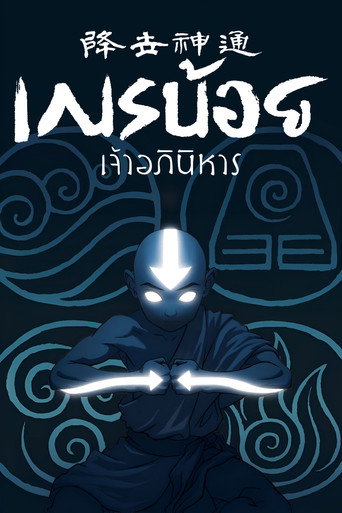
Avatar: The Last Airbender เณรน้อยเจ้าอภินิหาร (2005)
การ์ตูนแอนิเมชันซีรี่ย์ 2005แอนิเมชันแอ็กชันผจญภัยไซไฟแฟนตาซี
- ชื่อไทย
- เณรน้อยเจ้าอภินิหาร
- ชื่อภาษาอังกฤษ
- Avatar: The Last Airbender
- ประเทศ
- สหรัฐอเมริกา
- ออกอากาศครั้งแรก
- 21 กุมภาพันธ์ 2548
- จำนวนตอน
- 61 ตอน (3 ซีซัน)
- ความยาวต่อตอน
- ประมาณ 24 นาที
- สถานะ
- จบแล้ว
- ตอนล่าสุด
- EP21/21 (19 กรกฎาคม 2551)
- ช่อง/แพลตฟอร์มต้นทาง
- Nickelodeon
- ผู้สร้าง
- Michael Dante DiMartino, Bryan Konietzko
- เรตผู้ชม
- TV-Y7
- คะแนน TMDB
- 8.8/10 (5,154 โหวต)
เรื่องย่อ Avatar: The Last Airbender เณรน้อยเจ้าอภินิหาร
Avatar: The Last Airbender เณรน้อยเจ้าอภินิหาร เป็นการ์ตูนแอนิเมชัน ปี 2005 มีทั้งหมด 61 ตอน สถานะจบแล้ว
สองพี่น้องคาทาราและซ็อกกาปลุกเด็กน้อยแองให้ตื่นจากการจำศีลอันยาวนาน และได้รู้ว่าเขาคือร่างอวตารที่สามารถเอาชนะเผ่าอัคคีที่ชั่วร้ายได้ด้วยพลังควบคุมลมของเขา
Avatar: The Last Airbender เณรน้อยเจ้าอภินิหาร ดูได้ที่ไหน (ถูกลิขสิทธิ์)
สตรีมมิ่ง (สมาชิก)
 Netflix
เปิดแอปหรือเว็บไซต์ของผู้ให้บริการแล้วค้นหาชื่อเรื่องนี้ได้เลย ข้อมูลผู้ให้บริการในประเทศไทยจาก JustWatch อาจเปลี่ยนแปลงตามสัญญาลิขสิทธิ์ของแต่ละแพลตฟอร์ม
นักแสดง Avatar: The Last Airbender เณรน้อยเจ้าอภินิหาร
 Zach Tyler Eisenรับบท Aang (voice)
 Mae Whitmanรับบท Katara (voice)
 Jack De Senaรับบท Sokka (voice)
 Dante Bascoรับบท Zuko (voice)
 ดี แบรดลี่ เบเกอร์รับบท Appa / Momo (voice)
 Michaela Jill Murphyรับบท Toph Beifong (voice)
 Makoรับบท Iroh (voice)
 Cricket Leighรับบท Mai (voice)
 เกรย์ ดีไลล์รับบท Azula (voice)
 Olivia Hackรับบท Ty Lee (voice)
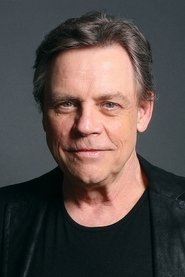 มาร์ก แฮมิลล์รับบท Ozai / Baboon Spirit (voice)
 Jennie Kwanรับบท Suki / Actress Yue (voice)
ซีซันและรายชื่อตอน
- Avatar: The Last Airbender เณรน้อยเจ้าอภินิหาร เล่ม 1: นํ้า20 ตอน · 21 กุมภาพันธ์ 2548
- Avatar: The Last Airbender เณรน้อยเจ้าอภินิหาร เล่ม 2: โลก20 ตอน · 17 มีนาคม 2549
- Avatar: The Last Airbender เณรน้อยเจ้าอภินิหาร เล่ม 3: ไฟ21 ตอน · 21 กันยายน 2550
รีวิว Avatar: The Last Airbender เณรน้อยเจ้าอภินิหาร จากทีมงาน
เจาะลึก Avatar: The Last Airbender เณรน้อยเจ้าอภินิหาร: เนื้อเรื่อง การสร้าง และเสียงวิจารณ์
Avatar: The Last Airbender (also known as Avatar: The Legend of Aang in some regions, Avatar, or ATLA) is an American animated fantasy action television series created by Michael Dante DiMartino and Bryan Konietzko. Produced by Nickelodeon Animation Studio, it originally aired on Nickelodeon for three seasons from February 2005 to July 2008.
The series is set in a largely Asian-inspired world in which some people can telekinetically manipulate one of the four elements—water, earth, fire or air—through practices known as "bending", inspired by Chinese martial arts. The only individual who can bend all four elements, the "Avatar", is responsible for maintaining harmony among the world's four nations, and serves as the link between the physical and spirit worlds. The series follows the journey of twelve-year-old Aang, the current Avatar and last survivor of his nation, the Air Nomads, along with his friends Katara, Sokka, and Toph, as they strive to end the Fire Nation's war against the other nations and defeat Fire Lord Ozai before he conquers the world. The series also follows Zuko—the exiled prince of the Fire Nation, seeking to restore his lost honor by capturing Aang, accompanied by his uncle Iroh—and later, his sister Azula. Avatar: The Last Airbender is presented and animated in a style that combines Japanese anime influences with those of American cartoons and relies on the imagery of primarily Chinese culture, with various other influences from different East Asian, Southeast Asian, South Asian, North Asian, and indigenous American cultures.
Avatar: The Last Airbender was a ratings success and received widespread acclaim from critics and audiences, with high praise given to its characters, cultural references, art direction, voice acting, soundtrack, humor, ending, and thematic content. The series explores themes rarely touched on in youth entertainment, such as war, genocide, sexism, gender roles, imperialism, totalitarianism, class warfare, political corruption, indoctrination, animal cruelty, fate, and free choice. It won five Annie Awards, a Genesis Award, a Primetime Emmy Award, a Kids' Choice Award, and a Peabody Award. Since its release, the show has been regarded by critics as one of the most acclaimed series of the 21st century, and one of the greatest animated television series of all time.
The extended franchise includes an ongoing comics series, a prequel novel series, two animated sequel series, a live-action film, and a Netflix live-action adaptation series. The complete series was released on Blu-ray in June 2018 in honor of the tenth anniversary of its finale and was made available to stream on Netflix in the United States and Canada in May 2020, on Paramount+ in June 2020, and on Amazon Prime Video in January 2021. A direct animated sequel film was scheduled to release theatrically, but was instead released on Paramount+ in July 2026.
Setting
Avatar: The Last Airbender is set in a world where human civilization consists of four nations, named after the four classical elements: the Water Tribe, the Earth Kingdom, the Fire Nation, and the Air Nomads. In each nation, certain people, known as "benders" (waterbenders, earthbenders, firebenders, and airbenders), have the ability to telekinetically manipulate and control the element corresponding to their nation, using gestures based on Chinese martial arts. The "Avatar" is the only individual with the ability to bend all four elements.
The Avatar is an international arbiter whose duty is to maintain harmony among the four nations, and act as a mediator between humans and spirits. When the Avatar dies, their spirit is reincarnated in a new body, who will be born to parents in the next nation in a set order known as the Avatar cycle: Fire, Air, Water, and Earth. By tradition, the new Avatar will travel the world to learn all four bending arts, after which they will begin in earnest their role as global peacekeeper. The Avatar can enter a condition known as the "Avatar State", in which they temporarily gain the skills and knowledge of all their past incarnations. Although this is when they are at their most powerful, if the Avatar were ever killed while in the Avatar State, the reincarnation cycle would be broken and the Avatar would cease to exist.
Synopsis
A century ago, young Avatar Aang, afraid of his new responsibilities, fled from his home and was forced into the ocean by a storm. He encased himself and his sky bison Appa in suspended animation in an iceberg near the South Pole. Shortly afterward, Fire Lord Sozin, the ruler of the Fire Nation, launched a world war to expand his nation's empire. Knowing that the Avatar must be an Air Nomad, he and his army carried out a genocide against the Air Nomads, which he timed with the arrival of a comet that gives firebenders tremendous power. A hundred years later, siblings Katara and Sokka, teenagers of the Southern Water Tribe, accidentally discover Aang and revive him.
In the first season, Aang travels with Katara and Sokka to the Northern Water Tribe to learn waterbending and be prepared to defeat the Fire Nation. Prince Zuko, the banished son of Fire Lord Ozai, pursues them, accompanied by his uncle Iroh, hoping to capture the Avatar in order to restore his honor. Aang is also pursued by Zhao, a Fire Nation admiral aspiring to win Ozai's favor. When his navy attacks the Northern Water Tribe, Zhao kills the moon spirit; Yue, the princess of the tribe, sacrifices her life to revive it, and Aang drives off the enemy fleet.
In the second season, Aang learns earthbending from Toph Beifong, a blind earthbending prodigy. Zuko and Iroh become refugees in the Earth Kingdom, eventually settling in its capital Ba Sing Se. Aang's group travels to Ba Sing Se to seek the Earth King's support for an attack on the Fire Nation during an upcoming solar eclipse, during which firebenders will be powerless. Both groups are pursued by Azula, Zuko's younger sister. Azula infiltrates Ba Sing Se and instigates a coup d'état against the Earth King, bringing the capital under Fire Nation control. Zuko betrays Iroh and returns to the Fire Nation.
In the third season, Aang and his allies invade the Fire Nation during the eclipse, but are forced to retreat. Zuko abandons the Fire Nation to teach Aang firebending. Aang, raised to respect all life, wrestles with the possibility that he will have to kill Ozai to end the war. When Sozin's comet returns, Aang confronts Ozai and uses his Avatar powers to strip Ozai of his firebending ability; meanwhile, Aang's friends liberate Ba Sing Se, destroy the Fire Nation airship fleet, and capture Azula. Zuko is crowned the new Fire Lord and the war comes to an end.
Episodes
The series consists of sixty-one episodes. The first episode—an-hour-long premiere—aired on February 21, 2005, on Nickelodeon. The series concluded with a two-hour television movie broadcast on July 19, 2008. Each season of the series is known as a "book", in which each episode is referred to as a "chapter". Each book takes its name from one of the elements Aang must master: Water, Earth, and Fire. The show's first two seasons each consists of twenty episodes and the third season twenty-one. The entire series has been released on DVD in regions 1, 2, and 4.
As of May 2020, the complete series is available on Netflix in the United States. It became the most popular show on U.S. Netflix within the first week of its release there, despite not being featured on the main page. The show broke the record for longest consecutive appearance on Netflix's daily top ten list, with 60 straight days on the list, one of only two shows in the top ten record holders that was not a Netflix original series as of July 2020. Later in June 2020, the complete series became available on Paramount+ (at the time CBS All Access) and later on Amazon Prime Video in January 2021.
Conception and production
The creators and producers of Avatar: The Last Airbender, Michael Dante DiMartino and Bryan Konietzko, met at a Halloween party in 1995 during their time as students in the Rhode Island School of Design, and began their professional partnership later that year when Konietzko assisted DiMartino in painting backgrounds and cels for the latter's student film. DiMartino and Konietzko moved to Los Angeles in 1996 and 1998 respectively to pursue careers in the animation industry. In between jobs, DiMartino animated a short titled Atomic Love that he pitched as a TV series, but was unsuccessful due to the amount of robot-based animated series already in development. During Konietzko's stint as an art director on Invader Zim, he and DiMartino formulated the idea of pitching a coming-to-age series based on their childhoods, but were too busy with their respective jobs to solidify the concept. When Invader Zim was abruptly canceled in January 2002, Konietzko declared to DiMartino his resolution to get their idea made at all cost.
By this time, Konietzko had established a good relationship with Nickelodeon head of development Eric Coleman, who was interested in the prospect of Konietzko creating and pitching his own show. Upon the end of his job on Invader Zim, Konietzko met with Coleman, introduced him to DiMartino and discussed their intent to create a series that held heart and integrity while meeting the network's commercial requirements. Although their meeting went well, Coleman revealed that the network was not looking for coming-of-age stories based on human characters. He added that the network was following the success of the Lord of the Rings and Harry Potter film series and was thus searching for non-violent action and adventure concepts with an emphasis on legends and lore. Lastly, he established that the show would require the point-of-view of either a kid hero or a non-human character, emphasizing that middle-aged human protagonists would be off-brand for Nickelodeon. Konietzko concluded the meeting with the promise of a pitch along those directives within a month.
DiMartino and Konietzko indiscriminately laid out their conceptual sketches in their effort to establish a new idea. Among them was a sketch that Konietzko created during his time on Invader Zim, which featured a robot cyclops monkey with an arrow on his head and holding a staff, a balding middle-aged man in a futuristic outfit, and a bipedal polar bear-dog hybrid. Konietzko's sketch, a "half-baked" sci-fi adventure, was primarily influenced by Cowboy Bebop. Recalling Coleman's advice against middle-aged main characters, Konietzko redrew the human character as a boy, but retained his baldness and transferred the robot's staff and arrow to him. After adding the new drawing to the collection of sketches, Konietzko began drawing other fanciful animal hybrids, which culminated in a drawing of a good-natured and nomadic "Huck Finnesque" boy herding a group of flying bison-manatee hybrids. The sketch was influenced by the works of renowned anime film director Hayao Miyazaki, of whom Konietzko and DiMartino were fans.
DiMartino drew inspiration for what would become the Southern Water Tribe from a documentary on the Imperial Trans-Antarctic Expedition, and he pitched Konietzko the idea of a group of people similarly trapped in the South Pole. Two weeks after their meeting with Coleman, Konietzko was suddenly inspired by DiMartino's idea and formulated a concept of a group of children in the South Pole who were terrorized by "fire people" and rescued by the young nomad from his earlier drawing. Konietzko and DiMartino reconvened that evening and began developing the series' setting over the next two weeks. Although DiMartino and Konietzko were themselves fans of the two successful British fantasy series that Nickelodeon sought to emulate, the pair chose to differentiate their own series by inserting influences from Asian cultures and philosophies, traditional martial arts, yoga, anime, and Hong Kong cinema. The co-creators successfully pitched the concept to Coleman with early sketches of Aang, Katara, and Sokka, three color images depicting the desired action, adventure, and magic aspects, and a description of the series' characters, setting and full story arc. The series was introduced to the public in a teaser reel at Comic-Con in July 2004, and premiered on February 21, 2005.
According to head writer Aaron Ehasz, Konietzko and DiMartino originally envisioned the series as three seasons long. However, Nickelodeon asked Ehasz about his ideas for a potential fourth season, which he later discussed with both Konietzko and DiMartino. Ehasz believed that a fourth season would be created, but this plan was interrupted when Konietzko and DiMartino decided to focus on assisting M. Night Shyamalan as executive producers for The Last Airbender film. Ehasz claims that Shyamalan insisted they create a fourth season, but Konietzko and DiMartino wanted to work on the live-action film and reverted to the original three-season plan. Konietzko and DiMartino have denied Ehasz's statements, asserting that a fourth season was never considered by them or Nickelodeon. Shyamalan has made comments that align with Ehasz's, such as acknowledging uncertainty at the time about whether the series would conclude after three seasons. Supporting the animated series going beyond three seasons, he nevertheless refused to sign on for the live-action adaptation, as he wanted to direct a trilogy.
Pilot
A pilot episode for the series was made in 2003. It was animated by Tin House, Inc., written by DiMartino and Konietzko, and directed by Dave Filoni. Mitchel Musso voiced Aang in this pilot but was later replaced by Zach Tyler Eisen when the show began production. In the episode, Sokka and his sister Kya (renamed Katara by the time the series aired) must travel the world to find masters for Aang, who is the Avatar; however, they must evade a critical foe, Prince Zuko of the Fire Nation, who wants to capture Aang.
This episode was first publicly released as one of the extras in the NTSC season 1 DVD box set, which were not available with the previously released individual volumes. As the PAL box set lacks extras, the episode was not made available on DVD in PAL regions. The episode was released with audio commentary from the creators which, unlike commentary on other episodes in the season, is not possible to disable on the DVD set. On June 14, 2010, the unaired pilot was made available with and without commentary for the first time via the iTunes Store. In 2020, the pilot was streamed on Twitch.
Influences
The series is notable for its extensive influence from East Asian culture, art and mythology for its universe, especially Chinese culture. Its creators employed cultural consultant Edwin Zane and Chinese calligrapher Siu-Leung Lee to help determine its art direction and settings. The creators have cited Chinese art and history, Hinduism, Taoism and Buddhism, and yoga as the strongest influences on the series.
Jeremy Zuckerman and Benjamin Wynn created the series' music and sound design together in the early developmental stages and then went on to divide the tasks, with Zuckerman taking on the musical composition and Wynn the sound design. They experimented with a wide range of instruments, including the guzheng, pipa, and duduk, to match the show's Asian-influenced setting.
The art style of the fictitious locations featured in the series are based on real locations in Asia. Sites such as the Forbidden City and the Great Wall of China in Beijing were inspirations for the Earth Kingdom city of Ba Sing Se, and Water Tribe locations were based on Inuit and Sireniki cultures. According to Ehasz, early Fire Nation designs were based on Japanese culture. To avoid accidentally making broad statements, they redesigned many settings and peoples to be more "broadly inspired". For the final design, the creators went with a more Chinese style for the Fire Nation's clothing and architecture. For instance, the Fire Temple was based on the Yellow Crane Tower, as its flame-like architectural elements were considered a perfect motif for the Fire Nation architecture, according to the creators.
The gestures used by the "bender" characters are derived from Chinese martial arts, for which the creators employed Sifu Kisu of the Harmonious Fist Chinese Athletic Association as a consultant. Each fighting style is unique to the "benders" who use them or characters who are aligned to a certain element. For example, practitioners of "waterbending" use movements influenced by tai chi and focus on alignment, body structure, breath, and visualization. Hung Gar was the inspiration for practitioners of "earthbending", and was chosen for its firmly rooted stances and powerful strikes as a representation of the solidity of earth. Northern Shaolin, which uses strong arm and leg movements, was chosen to represent "firebending". Baguazhang, which uses dynamic circular movements and quick directional changes, was used for "airbending". The Chu Gar Southern Praying Mantis style can be seen practiced by the earthbender, Toph, who develops a unique fighting style as a result of her blindness. Asian cinema also influenced the presentation of these martial-art bending moves.
Themes
The series addresses many topics rarely touched on in youth entertainment, including issues relating to war, genocide, imperialism, colonialism and totalitarianism, gender discrimination and female empowerment, marginalization and oppression, and spirituality, as well as philosophical questions surrounding fate, destiny, and free will.
The show is set during a period in which the world is engulfed in an imperialistic war initiated by the Fire Nation. While war is a constant backdrop, the show depicts these effects through the eyes of common people—the oppressed Earth Kingdom citizens as well as indoctrinated Fire Nation schoolchildren—to show how war can and does make victims of everyone. While the Fire Nation is presented as the instigator of violence, the show also depicts the systemic inequality experienced by residents in the Earth Kingdom city of Ba Sing Se as well as the nefarious activities of the city's corrupt secret police. These situations show the corrupting nature of power and the nuances of good and evil. The show introduces viewers to genocide early on when protagonist Aang visits his former home in the Southern Air Temple. He arrives to discover his people have been massacred and displays a range of emotions, such as rage, guilt, and sadness.
The character Zuko and his relationship with his father and Uncle Iroh is the main redemption arc of the series, and represents the show's message that destiny is not binding but rather can be changed. In season two, Zuko struggles to conform to the destiny and path determined by his father, but Iroh prods him, asking, "who are you, what do you want?"
The show also represents a diverse cast of characters in order to tackle the issue of marginalization. For example, in introducing a blind character like Toph and a paraplegic boy like Teo, the show depicts characters with vulnerabilities overcoming their physical and societal limitations. This is also true when it comes to the show's female characters. For example, female protagonist Katara faces systemic sexism when she reaches the Northern Water Tribe to learn waterbending, only to learn that girls and women are prohibited from doing so; a rule that is deeply ingrained within the culture. In another example, her brother Sokka initially espouses sexist viewpoints and is dismissive of the all-female Kyoshi Warriors, but learns to respect and appreciate their skills and mature as a person and fighter. According to Kirk Hamilton of Kotaku, these themes represent the show's message that it is more important to be oneself than to hew to societal expectations.
Ratings
Avatar: The Last Airbender was the highest-rated animated television series in its demographic at its premiere; an average of 1.1 million viewers watched each new episode. and was a highly rated part of the Nicktoons lineup beyond its 6-to-11-year-old target demographic. A one-hour special, The Secret of the Fire Nation, consisting of the episodes "The Serpent's Pass" and "The Drill", aired on September 15, 2006, and attracted 4.1 million viewers. According to the Nielsen ratings, the special was the fifth highest-rated cable television program that week. In 2007, Avatar: The Last Airbender was syndicated in more than 105 countries and was one of Nickelodeon's top-rated programs. The series ranked first on Nickelodeon in Germany, Indonesia, Malaysia, the Netherlands, Belgium, and Colombia.
The four-part series finale, "Sozin's Comet", had the highest ratings of the series. Its first airing averaged 5.6 million viewers, 195 percent more than Nickelodeon had in mid-July 2007. During the week of July 14, it was the most-viewed program by the under-14 demographic. The finale's popularity was reflected in online media; Rise of the Phoenix King, a Nick.com online game based on "Sozin's Comet", had almost 815,000 plays in three days.
เนื้อหาส่วนนี้มาจากบทความ "Avatar: The Last Airbender" ในวิกิพีเดีย (en.wikipedia.org) เผยแพร่ภายใต้สัญญาอนุญาตครีเอทีฟคอมมอนส์ แสดงที่มา-อนุญาตแบบเดียวกัน 4.0 (creativecommons.org/licenses/by-sa/4.0) มีการตัดส่วนอ้างอิงและจัดรูปแบบใหม่
คำถามที่พบบ่อยเกี่ยวกับ Avatar: The Last Airbender เณรน้อยเจ้าอภินิหาร
Avatar: The Last Airbender เณรน้อยเจ้าอภินิหาร มีกี่ตอน?
Avatar: The Last Airbender เณรน้อยเจ้าอภินิหาร มีทั้งหมด 61 ตอน รวม 3 ซีซัน สถานะปัจจุบัน: จบแล้ว
Avatar: The Last Airbender เณรน้อยเจ้าอภินิหาร ฉายวันไหน?
Avatar: The Last Airbender เณรน้อยเจ้าอภินิหาร เริ่มออกอากาศครั้งแรกวันที่ 21 กุมภาพันธ์ 2548
Avatar: The Last Airbender เณรน้อยเจ้าอภินิหาร ดูได้ที่ไหน?
ในประเทศไทยรับชม Avatar: The Last Airbender เณรน้อยเจ้าอภินิหาร แบบถูกลิขสิทธิ์ได้ที่ Netflix
หมวดแนะนำ: อนิเมะใหม่ · เรื่องถัดไป: Generator Rex เร็กซ์ พลังจักรกลมหาประลัย
ซีรี่ย์ที่คล้ายกับ Avatar: The Last Airbender เณรน้อยเจ้าอภินิหาร
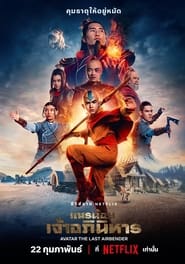 EP7/7★ 7.8
Avatar: The Last Airbender เณรน้อยเจ้าอภินิหาร (2024)
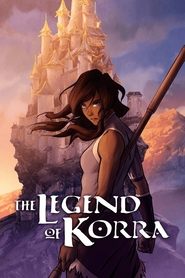 จบแล้ว 52 ตอน★ 8.2
The Legend of Korra (2012)
 EP10/10★ 7.8
Your Friendly Neighborhood Spider-Man (2025)
 จบแล้ว 42 ตอน★ 7.5
Kung Fu Panda: The Dragon Knight กังฟูแพนด้า อัศวินมังกร (2022)
 จบแล้ว 64 ตอน★ 7.6
Batman: The Brave and the Bold แบทแมน: ผู้กล้าและผู้ท้าทาย (2008)
 จบแล้ว 4 ตอน★ 8.2
Adventure Time: Distant Lands แอดแวนเจอร์ ไทม์ ดิสแทนซ์แลนด์ (2020)
 จบแล้ว 95 ตอน★ 8.2
Jackie Chan Adventures (2000)
 จบแล้ว 39 ตอน★ 8.3
Justice League Unlimited จัสติสลีค อันลิมิเต็ด (2004)
 จบแล้ว 5 ตอน★ 7.8
Masters of the Universe: Revolution ฮีแมน เจ้าจักรวาล: ปฏิวัติ (2024)
 ★ 8.3
★ 8.3Teen Titans ทีน ไททันส์ (2003)
 จบแล้ว 59 ตอน★ 8.4
Slugterra (2012)
 ★ 7.4
★ 7.4