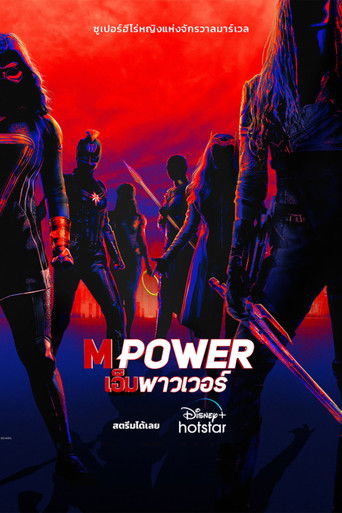
MPower เอ็มพาวเวอร์ (2023)
- ชื่อไทย
- เอ็มพาวเวอร์
- ชื่อภาษาอังกฤษ
- MPower
- ประเทศ
- สหรัฐอเมริกา
- ออกอากาศครั้งแรก
- 8 มีนาคม 2566
- จำนวนตอน
- 4 ตอน
- ความยาวต่อตอน
- ประมาณ 36 นาที
- สถานะ
- จบแล้ว
- ตอนล่าสุด
- EP4/4 (8 มีนาคม 2566)
- ช่อง/แพลตฟอร์มต้นทาง
- Disney+
- เรตผู้ชม
- TV-PG
- คะแนน TMDB
- 6.8/10 (32 โหวต)
เรื่องย่อ MPower เอ็มพาวเวอร์
MPower เอ็มพาวเวอร์ เป็นสารคดี ปี 2023 มีทั้งหมด 4 ตอน สถานะจบแล้ว
ชมประวัติศาสตร์และเรื่องราวที่ไม่เคยถูกเล่าขานของสตรีที่เป็นตำนานของมาร์เวล พร้อมเสียงจากแฟนๆ ที่มีเรื่องราวของซูเปอร์ฮีโร่เหล่านี้เป็นแรงบันดาลใจ
MPower เอ็มพาวเวอร์ ดูได้ที่ไหน (ถูกลิขสิทธิ์)
สตรีมมิ่ง (สมาชิก)
 Disney+
เปิดแอปหรือเว็บไซต์ของผู้ให้บริการแล้วค้นหาชื่อเรื่องนี้ได้เลย ข้อมูลผู้ให้บริการในประเทศไทยจาก JustWatch อาจเปลี่ยนแปลงตามสัญญาลิขสิทธิ์ของแต่ละแพลตฟอร์ม
นักแสดง MPower เอ็มพาวเวอร์
 โซอี ซาลแดนารับบท Self
 บรี ลาร์สันรับบท Self
 อลิซาเบธ โอลเซ่นรับบท Self
 แองเจลา บาสเซตต์รับบท Self
 Dominique Thorneรับบท Self
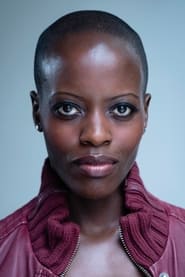 Florence Kasumbaรับบท Self
 Hannah Beachlerรับบท Self
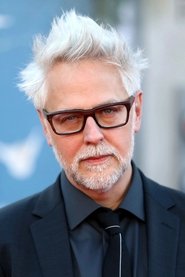 James Gunnรับบท Self
ซีซันและรายชื่อตอน
- MPower เอ็มพาวเวอร์ ซีซั่น 14 ตอน · 8 มีนาคม 2566
รีวิว MPower เอ็มพาวเวอร์ จากทีมงาน
เจาะลึก MPower เอ็มพาวเวอร์: เนื้อเรื่อง การสร้าง และเสียงวิจารณ์
The Marvel Cinematic Universe (MCU) is an American media franchise and shared universe centered on a series of superhero films produced by Marvel Studios, based on characters from American comic books published by Marvel Comics. The franchise is owned by the Walt Disney Company and includes television series, short films, digital series, and literature. The shared universe, much like the original Marvel Universe in comic books, was established by crossing over common plot elements, settings, cast, and characters.
Marvel Studios releases its films in groups called "Phases", with the first three phases collectively known as "The Infinity Saga" and the following three phases as "The Multiverse Saga". The first MCU film, Iron Man (2008), began Phase One, which culminated in the crossover film The Avengers (2012). Phase Two began with Iron Man 3 (2013) and concluded with Ant-Man (2015), while Phase Three began with Captain America: Civil War (2016) and concluded with Spider-Man: Far From Home (2019). Black Widow (2021) is the first film in Phase Four, which concluded with Black Panther: Wakanda Forever (2022), while Phase Five began with Ant-Man and the Wasp: Quantumania (2023) and concluded with Thunderbolts* (2025). Phase Six began with The Fantastic Four: First Steps (2025) and will conclude with Avengers: Secret Wars (2027).
Marvel Television expanded the universe to television, first on network television with Agents of S.H.I.E.L.D. on ABC in 2013 before further expanding to streaming television on Netflix and Hulu and to cable television on Freeform. They also produced the digital series Agents of S.H.I.E.L.D.: Slingshot (2016). Marvel Studios began producing its own television series for the streaming service Disney+, starting with WandaVision in 2021, marking the beginning of Phase Four. That phase also saw the studio expand to television specials, known as Special Presentations, starting with Werewolf by Night (2022). The MCU includes various tie-in comics published by Marvel Comics, a series of direct-to-video short films called Marvel One-Shots from 2011 to 2014, and viral marketing campaigns for some films featuring the faux news programs WHIH Newsfront (2015–16) and The Daily Bugle (2019–2022).
The franchise has been commercially successful, becoming one of the highest-grossing media franchises of all time, and it has received generally positive reviews from critics. However, many of the Multiverse Saga projects performed below expectations and struggled compared to those of the Infinity Saga. The studio has attributed this to the increased amount of content produced after the 2019 film Avengers: Endgame, and began decreasing its content output by 2024. The MCU has inspired other film and television studios to attempt similar shared universes and has also inspired several themed attractions, an art exhibit, television specials, literary material, multiple tie-in video games, and commercials.
The Infinity Saga films
By 2005, Marvel Entertainment was planning to produce its own films independently and distribute them through Paramount Pictures. Previously, Marvel had co-produced several superhero films based on Marvel Comics with Columbia Pictures, New Line Cinema, 20th Century Fox, and others. Marvel made relatively little profit from these licensing deals and wanted to get more money out of its films while maintaining artistic control of the projects and distribution. Avi Arad, head of Marvel Entertainment's film division known as Marvel Films, was pleased with director Sam Raimi's Spider-Man film trilogy (2002–2007) at Sony Pictures and Columbia but was less enthused with some of the other films. Arad decided to form Marvel Studios, Hollywood's first major independent film studio since DreamWorks Pictures was founded in 1994. Kevin Feige, Arad's second-in-command, realized that unlike Spider-Man, Blade, and the X-Men which were respectively licensed to Sony, New Line, and Fox, Marvel owned the rights to the Avengers team. Feige, a self-described "fanboy", envisioned introducing each of the Avengers in individual films and then merging them in a crossover film as part of a shared universe, similar to the one that was created by Stan Lee and Jack Kirby for Marvel Comics in the 1960s.
To raise capital, the studio secured funding from a seven-year, $525 million revolving credit facility with Merrill Lynch. Arad, who resigned in 2006, doubted the shared universe strategy would work. He insisted that his reputation helped secure the initial financing. In 2007, Feige was named studio chief and president. To preserve its artistic integrity, Marvel Studios formed a creative committee of six people familiar with its comic book lore: Feige, Marvel Studios co-president Louis D'Esposito, Marvel Comics' president of publishing Dan Buckley, Marvel Entertainment's chief creative officer Joe Quesada, comic book writer Brian Michael Bendis, and Marvel Entertainment president Alan Fine, who oversaw the committee. Feige initially referred to the shared narrative continuity of the films as the "Marvel Cinema Universe", but later used the term "Marvel Cinematic Universe". Since the franchise expanded to other media, some have used this phrase to only refer to the feature films.
The MCU films are released in groups called "Phases", beginning with Phase One (2008–2012) and Phase Two (2013–2015). In December 2009, the Walt Disney Company purchased Marvel Entertainment for $4 billion. Disney said future Marvel Studios films would be distributed by its own studio once the prior deal with Paramount expired. The films of Phase Three (2016–2019) were announced at a special press event in October 2014. By September 2015, Marvel Studios was integrated into Walt Disney Studios. Feige was reporting to Walt Disney Studios chairman Alan F. Horn instead of Marvel Entertainment CEO Isaac Perlmutter, and the creative committee began having only "nominal" input on the films. They continued to consult on Marvel Television productions, which remained under Perlmutter's control. All key film decisions moving forward were to be made by Feige, D'Esposito, and executive vice president Victoria Alonso. The studio went on to establish the Marvel Studios Parliament, a "brain trust" of long-time executives at the company who help to elevate each other's projects where possible. In November 2017, Feige said the Phase Three crossover films Avengers: Infinity War (2018) and Avengers: Endgame (2019) would provide a definitive conclusion to the films thus far and begin a new period for the franchise. He later said Phases One, Two, and Three were collectively known as "The Infinity Saga".
The Multiverse Saga films and series
Disney reportedly began developing a Marvel-based television series for its new streaming service Disney+ by November 2017. In July 2018, Feige said discussions had begun with Disney about Marvel Studios' potential involvement with the streaming service, which he felt was important for the wider company. In September 2018, Marvel Studios was reported to be developing several limited series centered on "second-tier" characters from the MCU films who had not and were unlikely to headline their own films, with Feige taking a "hands-on role" in each series' development. He said they would tell stories that could not be told with a feature film, and being asked by Disney to create these series had "energized everyone creatively" within Marvel Studios, since they "could play in a new medium and throw the rules out the window in terms of structure and format". Television specials from the studio are known as Special Presentations; The Guardians of the Galaxy Holiday Special (2022) was the first project Marvel Studios began planning for Disney+.
In July 2019, Feige announced the Phase Four (2021–2022) slate of films and series at San Diego Comic-Con (SDCC), including the animated series What If...? (2021–2024). By July 2021, the studio was creating an "animation branch and mini studio", known as Marvel Studios Animation, to focus on more animated content. Alonso said Marvel had around 31 projects in various stages of development by September 2021. In April 2022, Feige said he and Marvel Studios were on a creative retreat to plan and discuss the MCU films for the following 10 years. Following comments that there was no clear plan for the franchise in Phase Four compared to the Infinity Saga, Feige announced at SDCC in July 2022 that Phases Four, Five (2023–2025), and Six (2025–2027) would collectively be known as "The Multiverse Saga", and would culminate in the films Avengers: The Kang Dynasty and Avengers: Secret Wars (2027). Marvel Studios decided to not have an Avengers crossover film in each phase due to the large expansion in the number of MCU projects in a short amount of time, and after the "creative experience" of ending the Infinity Saga with Infinity War and Endgame. The studio was excited to explore Kang the Conqueror as an overarching villain of the Multiverse Saga after Thanos in the Infinity Saga, because Kang was a different villain in part due to his multiple alternate universe variants from different timelines within the multiverse. The studio did not initially plan to build the next saga around Kang, and made that decision after seeing actor Jonathan Majors's performance in the first season of the Disney+ series Loki (2021) and the film Ant-Man and the Wasp: Quantumania (2023).
Alonso was fired from her role at Marvel Studios in March 2023, allegedly due to her work with a competing studio, although she disputed this and claimed she was being "silenced" over the censoring of gay pride elements in Quantumania; Disney and Alonso reached a multi-million dollar compensation settlement in April. In July, Disney CEO Bob Iger said the company would be reducing the amount of content from Marvel Studios after several underachieving films at the box office, admitting that the expansion into Disney+ series and more films had "diluted focus and attention". He clarified in May 2024 that Disney would now release two, or at most three, Marvel films and two Marvel series a year. This was a decrease from up to four films and around four series in some recent years. The company was reducing output and focusing on quality across all its divisions, but Iger felt the change was especially needed for Marvel. Feige and D'Esposito said 2023 had been a particularly difficult year for the studio but they had learned their lesson on trying to make too much content at once. They said that no longer being "on top" of the box office allowed them to be underdogs again, as they were when they began work on Phase One, and they would be "coming back strong" with the hope of exceeding expectations. In 2024, Marvel Studios introduced the "Marvel Animation" and "Marvel Television" banners for their animated and live-action series, respectively. This was done, along with the previously established Marvel Spotlight banner, to indicate to audiences that they did not have to watch all of the studio's projects to understand the overall story and could choose which storylines and characters to follow. In July 2025, Feige said the studio reduced the budgets of its 2024 and 2025 films to be a third lower than those for 2022 and 2023.
After Majors was found guilty of assault and harassment amidst legal issues in December 2023, he was fired by Disney and Marvel Studios. At that time, Marvel was internally referring to The Kang Dynasty as Avengers 5; by early 2024, Marvel had decided to drop the Kang storyline and began searching for a new antagonist for the saga. At SDCC in July 2024, the fifth Avengers film was retitled Avengers: Doomsday (2026), with Robert Downey Jr.—who starred as the superhero Tony Stark / Iron Man in the Infinity Saga—cast as the Multiverse Saga's new antagonist Victor von Doom / Doctor Doom, for both Doomsday and Secret Wars.
== Integration of 21st Century Fox characters ==
In December 2017, Disney agreed to acquire assets from 21st Century Fox, and finalized the transaction in March 2019. This saw the return of the film rights for the X-Men, Deadpool, and the Fantastic Four to Marvel Studios. Despite this, Feige said they could not yet immediately integrate these characters and concepts into the MCU because of corporate acquisition laws. Some of the first elements to be integrated into the MCU following the acquisition were the organization S.W.O.R.D. in the Disney+ series WandaVision (2021) and the fictional country Madripoor in the series The Falcon and the Winter Soldier (2021).
More elements were integrated throughout the Multiverse Saga, including Patrick Stewart appearing as an alternate version of Charles Xavier, his role in Fox's X-Men film series, in the film Doctor Strange in the Multiverse of Madness (2022); "No Normal", the series finale of the miniseries Ms. Marvel (2022), revealing that Kamala Khan has a genetic mutation, with star Iman Vellani confirming that Kamala is the first mutant in the MCU; and Kelsey Grammer playing a version of his X-Men film series character Hank McCoy / Beast in the film The Marvels (2023). The film Deadpool & Wolverine (2024) features many returning characters and actors, including Ryan Reynolds as Wade Wilson / Deadpool, Hugh Jackman as a version of Logan / Wolverine, and Chris Evans—who starred as Steve Rogers / Captain America in the Infinity Saga—as Johnny Storm / Human Torch, reprising his role from Fox's Fantastic Four duology (2005–2007). Feige said Deadpool & Wolverine was the true start to Marvel Studios' use of the Fox characters, and began the MCU's "Mutant era". He said Fox characters would continue to appear through Doomsday and Secret Wars, which would introduce a "new age of mutants and of the X-Men" as part of a reported ten-year plan for the characters. Feige added that one of Marvel's goals for the crossover films was to give closure to storylines that pre-dated the MCU, including those of the Fox X-Men characters, before Secret Wars introduced a recast X-Men team. Doomsday sees additional X-Men film series actors reprising their roles: Ian McKellen (Erik Lehnsherr / Magneto), Alan Cumming (Kurt Wagner / Nightcrawler), Rebecca Romijn (Raven Darkhölme / Mystique), and James Marsden (Scott Summers / Cyclops).
The Phase Six film The Fantastic Four: First Steps (2025) introduces Pedro Pascal, Vanessa Kirby, Ebon Moss-Bachrach, and Joseph Quinn as a new version of the Fantastic Four for the MCU. Sadie Sink is introduced as a new version of Jean Grey in Spider-Man: Brand New Day (2026), with that film also featuring Bill Metzger, a radical anti-mutant activist in the comics; and a universal inhibitor that subdues mutant abilities.
= The Mutant Saga =
In July 2025, Feige said Marvel Studios was "already well into development" on the three phases of their next saga following the conclusion of the Multiverse Saga with Secret Wars. He said Phase Seven would be "directly impacted" by the films of Phase Six. By that point, Sacha Baron Cohen's Mephisto was being viewed as the next "prominent" villain of the MCU. A year later, Feige said Secret Wars would "establish a streamlined, simplified, single universe that audiences can keep up with. Some things will be familiar, but many, many things will be entirely new." He said the X-Men would be core to the next era of the MCU, which he called the "Mutant Saga", and noted that those characters have their own universe and "multi-stage saga" in the comics.
Marvel Television series
Marvel Television was launched in June 2010 with writer and producer Jeph Loeb as its head, and had entered into discussions with ABC to create a show set in the MCU by July 2012; the network went on to release Agents of S.H.I.E.L.D., Agent Carter, and Inhumans. The latter was a co-production with IMAX Corporation. In November 2013, Disney was set to provide Netflix with the live-action series Daredevil, Jessica Jones, Luke Cage, and Iron Fist, building up to the crossover miniseries The Defenders. In April 2016, Netflix ordered The Punisher, a spin-off of Daredevil. By February 2019, Netflix had canceled all of its Marvel series. In April 2016, the Disney-owned cable network Freeform announced Cloak & Dagger. In May 2017, Marvel announced that Runaways had received a series order from Hulu. In May 2019, Marvel announced that Helstrom had been greenlit for Hulu.
In October 2019, further corporate restructuring saw Feige named Chief Creative Officer of Marvel Entertainment, with Marvel Television becoming part of Marvel Studios and executives of Marvel Television reporting to Feige. In December 2019, Marvel Television was folded into Marvel Studios, with Marvel Studios taking over production of the remaining series and no further series expected to be developed by Marvel Television. In January 2021, Feige said "never say never" to potentially reviving the Netflix series, but noted that Marvel Studios was focused on their new Disney+ series. In May 2022, Marvel Studios was revealed to be developing a new Daredevil series for Disney+, which was announced in July as Daredevil: Born Again.
Expansion to other media
In 2008, the first comic book to tie into the MCU was released. Quesada explained that these comics would be set within the continuity of the films, but were not intended to be direct adaptations. Rather, they would explore "something that happened off screen" or flesh out something briefly mentioned. Feige was involved with the creation of the comics, with the film's screenwriters sometimes as well. Marvel Comics worked with Brad Winderbaum, Jeremy Latcham, and Will Corona Pilgrim at Marvel Studios to decide which concepts would be carried over from the Marvel Comics Universe to the Marvel Cinematic Universe, what to show in the tie-in comics, and what to leave for the films. Marvel later clarified which of the tie-in comics are considered canonical MCU stories, with the rest being merely inspired by the MCU "where we get to show off all the characters from the film in costume and in comic form".
In August 2011, Marvel announced a series of direct-to-video short films called Marvel One-Shots. The name was derived from the label used by Marvel Comics for their one-shot comics. Winderbaum said the shorts were "a fun way to experiment with new characters and ideas" and to expand the MCU. Each short was designed to be a self-contained story that provided more backstory for characters or events introduced in the films.
In March 2015, Marvel's vice president of animation development and production, Cort Lane, said animated tie-ins to the MCU were "in the works". That July, Marvel Studios partnered with Google to produce the faux news program WHIH Newsfront with Christine Everhart, a series of in-universe YouTube videos serving as the center of a viral marketing campaign to promote the films and universe. In December 2016, a six-part web series, Agents of S.H.I.E.L.D.: Slingshot, debuted on ABC.com. It follows Elena "Yo-Yo" Rodriguez on a secret mission, shortly before the start of Agents of S.H.I.E.L.D.'s fourth season, with Natalia Cordova-Buckley reprising her role from the series. In September 2019, Sony created a real version of the fictional The Daily Bugle website as part of a viral marketing campaign to promote the home media release of Spider-Man: Far From Home (2019). Inspired by real-world "conspiracy-pushing" websites such as Alex Jones's InfoWars, the website features J. K. Simmons reprising his role as J. Jonah Jameson in a video where he speaks out against Spider-Man before asking viewers to "like and subscribe". In December 2020, Marvel Studios announced I Am Groot, a series of photorealistic animated shorts starring Baby Groot for Disney+.
เนื้อหาส่วนนี้มาจากบทความ "MPower (TV series)" ในวิกิพีเดีย (en.wikipedia.org) เผยแพร่ภายใต้สัญญาอนุญาตครีเอทีฟคอมมอนส์ แสดงที่มา-อนุญาตแบบเดียวกัน 4.0 (creativecommons.org/licenses/by-sa/4.0) มีการตัดส่วนอ้างอิงและจัดรูปแบบใหม่
คำถามที่พบบ่อยเกี่ยวกับ MPower เอ็มพาวเวอร์
MPower เอ็มพาวเวอร์ มีกี่ตอน?
MPower เอ็มพาวเวอร์ มีทั้งหมด 4 ตอน สถานะปัจจุบัน: จบแล้ว
MPower เอ็มพาวเวอร์ ฉายวันไหน?
MPower เอ็มพาวเวอร์ เริ่มออกอากาศครั้งแรกวันที่ 8 มีนาคม 2566
MPower เอ็มพาวเวอร์ ดูได้ที่ไหน?
ในประเทศไทยรับชม MPower เอ็มพาวเวอร์ แบบถูกลิขสิทธิ์ได้ที่ Disney+
หมวดแนะนำ: ซีรี่ย์ฝรั่งแนะนำ · เรื่องถัดไป: Justice
ซีรี่ย์ที่คล้ายกับ MPower เอ็มพาวเวอร์
 ★ 7.4
★ 7.4Marvel's 616 มาร์เวล 616 (2020)
 ★ 7.4
★ 7.4Marvel Studios Legends มาร์เวลสตูดิโอส์: เลเจนด์ (2021)
 ★ 7.2
★ 7.2Marvel Studios Assembled มาร์เวลสตูดิโอส์: แอสเซมเบิลด์ (2021)
 จบแล้ว 3 ตอน★ 7.4
Superpowered: The DC Story (2023)
 จบแล้ว 8 ตอน★ 8.0
Animal สัตว์มหัศจรรย์ (2021)
 EP6/6★ 8.1
The Imagineering Story เรื่องราวแห่งจินตนาการ (2019)
 EP4/9★ 7.5
How Do They Do It? (2006)
 จบแล้ว 10 ตอน★ 7.4
A Real Bug's Life (2024)
 จบแล้ว 62 ตอน★ 7.6
Through the Wormhole (2010)
 จบแล้ว 11 ตอน★ 7.4
Disney Gallery / Star Wars: The Mandalorian ดิสนีย์ แกลลอรี่ / สตาร์ วอร์ส: เดอะ แมนดาลอเรี่ยน (2020)
 จบแล้ว 6 ตอน★ 7.4
Watch the Sound with Mark Ronson (2021)
 EP5/5★ 8.0