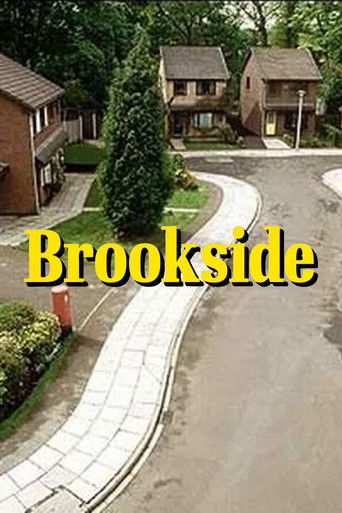
Brookside (1982)
ซีรี่ย์อังกฤษซีรี่ย์ 1982ละครชุดดราม่า
- ประเทศ
- สหราชอาณาจักร
- ออกอากาศครั้งแรก
- 2 พฤศจิกายน 2525
- จำนวนตอน
- 2915 ตอน (22 ซีซัน)
- ความยาวต่อตอน
- ประมาณ 90 นาที
- สถานะ
- จบแล้ว
- ตอนล่าสุด
- EP132/132 (4 พฤศจิกายน 2546)
- ช่อง/แพลตฟอร์มต้นทาง
- Channel 4
- ผู้สร้าง
- Phil Redmond, Colin McKeown
- คะแนน TMDB
- 6.4/10 (21 โหวต)
เรื่องย่อ Brookside
Brookside เป็นซีรี่ย์อังกฤษ ปี 1982 มีทั้งหมด 2915 ตอน สถานะจบแล้ว
ยังไม่มีเรื่องย่อภาษาไทย แสดงเรื่องย่อต้นฉบับภาษาอังกฤษ
The ground-breaking soap set in a housing estate on the outskirts of Liverpool.
Brookside ดูได้ที่ไหน (ถูกลิขสิทธิ์)
ยังไม่พบข้อมูลผู้ให้บริการที่มีลิขสิทธิ์เรื่องนี้ในประเทศไทย ต้นทางออกอากาศทาง Channel 4 เราจะอัปเดตทันทีเมื่อมีแพลตฟอร์มนำเข้ามาฉาย
นักแสดง Brookside
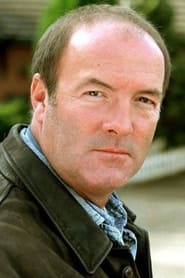 Dean Sullivanรับบท Jimmy Corkhill
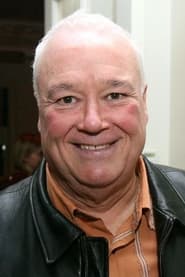 Michael Starkeรับบท Thomas 'Sinbad' Sweeney
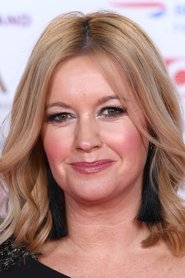 Alex Fletcherรับบท Jacqui Dixon/Jacqui Farnham
- Paul Usherรับบท Barry Grant
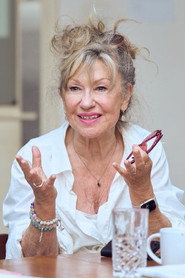 Sue Jenkinsรับบท Jackie Corkhill
 Claire Sweeneyรับบท Lindsey Corkhill
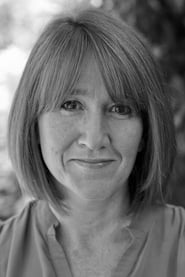 Sarah Whiteรับบท Bev Dixon
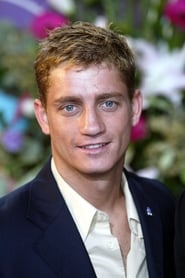 Philip Olivierรับบท Tim 'Tinhead' O'Leary
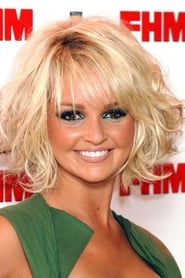 Jennifer Ellisonรับบท Emily O'Leary
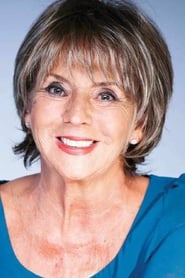 Sue Johnstonรับบท Sheila Grant
- Peter Christianรับบท Frank Blackburn
 Kenneth Copeรับบท Ray Hilton
ซีซันและรายชื่อตอน
- Brookside Season 118 ตอน · 2 พฤศจิกายน 2525
- Brookside Season 2104 ตอน · 4 มกราคม 2526
- Brookside Season 3105 ตอน · 3 มกราคม 2527
- Brookside Season 4105 ตอน · 1 มกราคม 2528
- Brookside Season 5104 ตอน · 6 มกราคม 2529
- Brookside Season 6104 ตอน · 5 มกราคม 2530
- Brookside Season 7107 ตอน · 4 มกราคม 2531
- Brookside Season 8104 ตอน · 2 มกราคม 2532
- Brookside Season 9131 ตอน · 1 มกราคม 2533
- Brookside Season 10156 ตอน · 2 มกราคม 2534
- Brookside Season 11157 ตอน · 1 มกราคม 2535
- Brookside Season 12157 ตอน · 1 มกราคม 2536
- Brookside Season 13156 ตอน · 3 มกราคม 2537
- Brookside Season 14160 ตอน · 3 มกราคม 2538
- Brookside Season 15162 ตอน · 2 มกราคม 2539
- Brookside Season 16163 ตอน · 1 มกราคม 2540
- Brookside Season 17163 ตอน · 2 มกราคม 2541
- Brookside Season 18157 ตอน · 1 มกราคม 2542
- Brookside Season 19157 ตอน · 4 มกราคม 2543
- Brookside Season 20156 ตอน · 2 มกราคม 2544
- Brookside Season 21157 ตอน · 2 มกราคม 2545
- Brookside Season 22132 ตอน · 4 มกราคม 2546
รีวิว Brookside จากทีมงาน
เจาะลึก Brookside: เนื้อเรื่อง การสร้าง และเสียงวิจารณ์
Brookside is a British television soap opera, set in Liverpool, England, which began on 2 November 1982, and ran for 21 years until 4 November 2003. It was produced by Mersey Television and conceived by Grange Hill and Hollyoaks creator Phil Redmond.
Brookside was Channel 4's highest rated programme from the mid-1980s to the mid-1990s, with audiences regularly in excess of seven million. Initially notable for its realistic and socially challenging storylines, Brookside is remembered for broadcasting the first pre-watershed lesbian kiss on British television, and a domestic abuse storyline resulting in murder. From the mid-1990s the show began raising more controversial subjects under producers Mal Young and Paul Marquess, and experienced an extreme backlash from viewers in 1996 following a hugely controversial storyline focusing on an incestuous sexual relationship between two siblings; from thereon the show became synonymous with outrageous and improbable storylines that affected its popularity. Viewing figures were in terminal decline by 2000, and low ratings eventually led to its cancellation, with the final episode airing on 4 November 2003.
From February 2023, Brookside has been available to stream from the first episode on STV Player.
Brookside's location and former cast members were involved in a crossover episode with Hollyoaks on 22 October 2025, as part of the latter's 30th anniversary. Elements from the show were also included in the late night Hollyoaks Later special that also broadcast on 22 October 2025 with Brookside Close featuring at the beginning of the episode.
Conception and preparation
Phil Redmond has first conceived the idea for a drama serial centred on a newly-built housing estate in 1973, while writing for sitcom Doctor in Charge. He pitched the programme to several ITV production companies, but it was not picked up and Redmond abandoned it. In 1981 he attended a lecture given at the Royal Institution of Great Britain by Jeremy Isaacs, the chief executive of newly-commissioned Channel 4, who was looking for independent producers that could provide content for the channel, which led to Redmond promising Isaacs a format for a drama serial and revisiting his original concept. After previous clashes with the BBC during production of Grange Hill, Redmond established production company Mersey Television to maintain control over his future programmes; Brookside would be its first product.
In early 1982, Mersey Television purchased 13 houses on a cul-de-sac in Croxteth, Liverpool, on land formerly a part of Lord Sefton's estate. Six of the houses would be seen on-screen as sets, while the remaining seven were used for administration, post-production and canteen facilities. The cul-de-sac backed onto the River Alt, which lent the programme its name, replacing Redmond's original title Meadowcroft (which would later be recycled for the show's in-universe soap opera, Meadowcroft Park). The houses cost a total of £25,000 and were custom-built by Broseley Homes. Using houses on a real new-build estate added to the desired realism Redmond wanted.
Ahead of the first episode in November, Redmond gave an interview to Liverpool Echo in March 1982 describing the show as "a cross between Knots Landing [...] and Coronation Street", and stated his intention to have Brookside deal realistically with issues faced by its potential viewers. The article also included a overview of the characters, including mention of a black family called the Manchesters, who were later scrapped during the production process. Actors that were unfamiliar to the public were cast to enhance the credibility of the characters; the ensemble was smaller than other soaps, having only 16 regular characters and only three of the six houses occupied. This was an intentional choice made to reflect the reality of new-build estate occupancy, and it was over a year until all the houses were full. Shooting for the first episode began on 6 September 1982.
1980s
Central to much of the show's early publicity were the working-class Grant family - socialist factory worker Bobby (Ricky Tomlinson), devout Catholic Sheila (Sue Johnston), and their children Barry (Paul Usher), Karen (Shelagh O'Hara) and Damon (Simon O'Brien) - who moved into 5 Brookside Close from a rundown council estate. Bobby and Sheila's turbulent marriage proved popular, as Bobby's socialist principles clashed with Sheila's traditional family values. The Grants contrasted their conservative, middle-class neighbours Paul (Jim Wiggins) and Annabelle Collins (Doreen Sloane), and their children Lucy (Katrin Cartlidge/Maggie Saunders) and Gordon (Nigel Crowley/Mark Burgess), who downsized from a large home on the Wirral to Number 8 after Paul was made redundant from his executive position at a chemical plant. Much of the early storylines were driven by the social and political differences between the left-wing Grants and the right-wing Collinses. Number 9 was occupied by solicitor's clerk Roger Huntington (Rob Spendlove) and his wife, ambitious accountant Heather (Amanda Burton), who together represented the emerging yuppie subculture. Roger, who was ashamed of his working-class roots, sided with the Collinses against the Grants; Belfast-born Heather was friendly with both families. Low-class newlyweds Gavin (Danny Webb) and Petra Taylor (Alexandra Pigg) arrived next-door to the Huntingtons at Number 10 at the end of November, and Gavin infuriated their neighbours by selling stolen gas cookers from his front lawn.
The first episode was watched by 4.2 million viewers, but initial reactions were far from positive. Critics were quick to point out various technical problems, as well as the swearing now being screened before the watershed. As viewing figures stabilised at 1 million, the production team started to iron out the show's teething troubles. Soundproof panels were placed on the ceilings of the houses to contain sound and eliminate echoing, and scriptwriters toned down the language and removed a couple of poorly performing supporting actors. The atmosphere changed as the rest of the original cast arrived in 1983: computer programmer Alan Partridge (a character played by Dicken Ashworth and unrelated to the later comedy character of the same name) moved into Number 6 in April, and pensioners Harry (Bill Dean) and Edna Cross (Betty Alberge) bought Number 7, arriving in November. Following the death of Gavin and the disappearance of Petra, Number 10 became home to Petra's sisters Michelle Jones (Tracey Jay) and Marie Jackson (Anna Keaveney), along with Marie's husband George (Cliff Howells) and their twin sons, Gary and Little George (Allan and Steven Patterson). These new characters expanded the cast whilst helping to bring humour and balance to the existing dynamic. By 1984, off the back of the popular "Free George Jackson" storyline, Brookside had achieved mainstream popularity, being voted best programme of the year by separate polls in Smash Hits and No.1 magazines.
Brookside topped 7 million for the first time in 1985 following a dramatic siege storyline that proved popular with viewers, despite criticism of the unlikeliness of the plot (Hilary Kingsley described it as "ludicrous") and the killing of the programme's only black character, Kate Moses (Sharon Rosita). September that year saw the arrival of the first generation of the Corkhill family, Billy (John McArdle), Doreen (Kate Fitzgerald), Rod (Jason Hope) and Tracy (Justine Kerrigan), accompanied by Doreen's malapropping mother Julia Brogan (Gladys Ambrose) and Billy's ne'er-do-well brother Jimmy (Dean Sullivan).
The late 1980s saw two spin-offs, referred to as "soap bubbles". The first, 1987's Damon and Debbie, focussed on the relationship between Damon Grant and schoolgirl Debbie McGrath (Gillian Kearney) as they fled their families in Liverpool to make their own life in York; the series ended in Damon's death, being stabbed while defending himself from a mugger. The second, 1988's South, featured Tracy Corkhill and Jamie Henderson (Sean McKee) heading to London to find employment, sick of the lack of opportunities in Merseyside. The spin-offs were both written by regular Brookside contributor Frank Cottrell-Boyce, and were woven into the narrative of Brookside as well, particularly Damon and Debbie, as scriptwriters explored the grief of Bobby and Sheila at their youngest son's death. The episode featuring Damon's funeral gained 7 million viewers, and also introduced the Rogers family. Lorry driver Frank (Peter Christian) and his wife Chrissy (Eithne Brown) had three children, Sammy (Rachael Lindsay), Geoff (Kevin Carson/Stephen Walters) and Katie (Debbie Reynolds/Diane Burke), and became the show's new nuclear family following the disintegration of the Grants. This status was solidified by the Rogers family buying the Grants' old house, Number 5, at auction in May 1989. Other storylines at this time included the slow-burning romance between divorcees Billy Corkhill and Sheila Grant, and the marriage of longtime resident Terry Sullivan (Brian Regan) and his pregnant girlfriend Sue Harper (Annie Miles).
1990s
Many long-standing characters departed in 1990. Harry Cross moved to St Helens in May; the entire Collins family was written out by June, following the sudden death of actress Doreen Sloane; Billy and Sheila Corkhill, having married in August, departed for Basingstoke in September; and solicitor Jonathan Gordon-Davies (Steven Pinner), who had bought Number 9 in 1987, left for London in October. The departures made way for an influx of new characters who arrived in rapid succession. Harry Cross's lodger Mick Johnson (Louis Emerick) took full residence of Number 6, and was joined by his wife Josie (Suzanne Packer) and their children, Leo (Leeon Sawyer/Steven Cole) and Gemma (Naomi Kamanga) in May; quantity surveyor Max Farnham (Steven Pinder) and his wife, public relations consultant Patricia (Gabrielle Glaister), bought Number 7 in July, moving in with their infant son Thomas (Kieran Warham) and live-in nanny Margaret Clemence (Nicola Stephenson); and working-class Ron (Vince Earl) and DD Dixon (Irene Marot) moved into Number 8 in October, accompanied by their three children Mike (Paul Byatt), Jacqui (Alexandra Fletcher) and Tony (Gerard Bostock/Mark Lennock) and "The Moby", their mobile shop. The dynamic between the Dixons and the Farnhams echoed that of the Grant and Collins families at the show's inception, and there remained a strong rivalry between them until Brookside's demise. The Rogers family remained at Number 5, the Sullivans at Number 9 with son Danny (Kieran Poole), and siblings Rod and Tracy Corkhill continued living at Number 10 with new stepbrother Barry Grant. Barry, now without any of his biological family to ground him, descended further into Liverpool's criminal underworld.
Even with the near-wholesale cast change, ratings were regularly topping 7 million and a third weekly episode was added from 1 July 1990. To accommodate this, Mersey Television bought a defunct technical college in nearby Childwall, planning to incorporate it into the programme as a row of shops called Brookside Parade, most of which would be owned by residents of Brookside Close.
Brookside's most famous storyline, known as "The Body Under the Patio", involved the murder of wife-beater and child abuser Trevor Jordache (Bryan Murray) in May 1993, at the hands of his wife Mandy (Sandra Maitland) and daughter Beth (Anna Friel). His body was unceremoniously buried beneath the patio at Number 10 and remained there until its unearthing in January 1995 during a search for a leaking water pipe. The trial and imprisonment of Mandy and Beth Jordache captivated viewers and drew Brookside's highest ratings of 9 million viewers. The storyline was inspired by a 1990 murder in the West Midlands, when a woman killed her abusive husband and buried him in her garden. The Jordache family contributed heavily to the show's appeal, especially through Beth Jordache sharing the first televised pre-watershed lesbian kiss with Margaret Clemence, and Mandy's relationship with popular long-standing character Sinbad (Michael Starke). However, the conclusion to their storyline drew criticism when Beth suddenly died off-screen from an undiagnosed heart disease while incarcerated for Trevor's murder and waiting for an appeal hearing. The character's death came when Anna Friel decided not to renew her contract and quit the role; executive producer Redmond explained to disappointed viewers at the time that he felt it would not be right to leave the character languishing in prison. Mandy Jordache left shortly afterward, having been acquitted and given birth to hers and Sinbad's daughter, which left only youngest child Rachel (Tiffany Chapman), who remained until the programme's end.
Following the conclusion of the Jordache family's story, writers persisted with contentious and sensational storylines to keep ratings high and Brookside in the headlines. In 1996, an incest storyline between siblings Georgia (Helen Grace) and Nat Simpson (John Sandford) drew substantial backlash, especially as they were caught in bed by younger brother Danny (Andrew Butler). In the aftermath of viewer complaints to the Independent Television Commission, Channel 4 were ordered to broadcast a public apology and Redmond admitted that he and the writers "got it wrong"; senior producer Mal Young also drew criticism for taking the programme away from its social-realist roots. Following the separate departures of Rod and Tracy Corkhill, their uncle Jimmy (Dean Sullivan) was joined by his estranged wife Jackie (Sue Jenkins) and daughter Lindsey (Claire Sweeney). Sweeney became popular among Brookside's audience, and Lindsey went through several different incarnations, moving from a downtrodden single mother to a formidable gun-toting gangster romantically involved with Barry Grant. Lindsey became so associated with guns that the Mersey Television publicity department released promotional pictures of Sweeney posing provocatively with a firearm. The complete transformation of the character was indicative of the improbable storylines, and Lindsey's spell as a gangster was described by Lorna Hughes of the Liverpool Echo as "best forgotten".
By 1998, viewing figures had fallen below 7 million and new Channel 4 chief executive Michael Jackson was considering cancelling the show. In response to the falling ratings, and criticisms for outlandish and dangerous plots that upset television watchdogs, producers shifted focus back onto the families and their dynamics within a close-knit community; Redmond would go on to comment that the Brookside of 1998 was closer to the show he had launched in 1982. Despite the attempt to return to realism and issue-led plots, Brookside had become synonymous with guns and explosions, and was losing support among its viewers and the press. Alison Graham, TV listing editor for Radio Times, dropped the show from her soap opera column in 1998 and replaced it with BBC Radio 4's rural soap The Archers.
2000s
2000 saw Brookside try and revamp itself for the new millennium, by reviving past characters Josie Johnson (Suzanne Packer), Bev McLoughlin (Sarah White), Leanne Powell (Vickie Gates) and Nisha Batra (Sunetra Sarker), and introducing pop singer Bernie Nolan in her first acting role as Diane Murray, the matriarch of a new nuclear family in Number 9. This succeeded in sparking a new interest in the programme, although many of the plots were felt to be rehashes of previously explored issues. The departure of the popular Sinbad in a controversial child abuse scandal, and a love triangle involving Lindsey Corkhill, Shelley Bowers (Alexandra Wescourt) and Lindsey's mother Jackie, were poorly received by viewers, and Redmond spoke out again: "NHS and childcare - these are the things that engage and worry people now. [...] I'm giving up the lesbian-affair-with-the-mother-in-law syndrome". One of the more successful plotlines was the death of Susannah Morrisey (Karen Drury) in a "Whodunit?" storyline that pushed viewing figures back over 6 million.
The ratings boost from Susannah's death did not last and by 2001, the programme was again in dire straits. Ratings dropped back below 5 million viewers, long-running characters Lindsey Corkhill, Mick Johnson, and Jackie Corkhill were written out, and producer Paul Marquess left to produce ITV's The Bill. Brookside had been renewed for four years in 1997, but by the time this contract ended in 2001 the show was far less important in Channel 4's programming. After a failed attempt to lure back Mal Young, Phil Redmond resumed total control shortly before Brookside's 20th anniversary, and marked the occasion by pledging to return the ailing programme to its former glory at a meeting attended by the cast and crew. The exteriors of the houses on Brookside Close received decoration, four members of the cast were axed, and several new directors and writers were hired. A new focal family, the Gordons, were introduced, and characters returned to discussing current political and environmental issues, but Redmond's grounded new-look approach did little to stop declining ratings. The Gordons were considered miscast and unlikeable, and were unfavourably compared to the original Grant family. As Brookside approached its twentieth anniversary in November 2002, ratings dropped below 1.8 million. In response, Channel 4 announced that the programme would be withdrawn from its prime-time evening slots on weeknights and instead be broadcast only in its Saturday omnibus slot. Channel 4 was contractually obligated to Brookside until November 2003, and the move was seen as damage limitation, hoping that the move would cease the dwindling audience share and let it die quietly. This announcement coincided with the programmes twentieth anniversary, which was unfortunate as the show celebrated the milestone with an updated theme tune, new opening credits and a post-production film effect to update visuals.
The twentieth anniversary storyline in November 2002, which also featured the return of Claire Sweeney as Lindsey Corkhill, involved four armed drug dealers ending up on Brookside Close after taking a wrong turn during a police chase. Finding themselves cornered, they raided the houses and took several residents hostage in their homes. The scenes featured graphic violence, profanity and cocaine consumption, and culminated with a police helicopter crashing and exploding onto the car park outside Brookside Parade. The storyline drew comparison to a similar 1993 storyline from Emmerdale, which had also been devised by Phil Redmond to save the flagging soap. Unlike Emmerdale, which was saved by its storyline, Brookside faced criticism for the unrealistic premise and unsuitability for pre-watershed viewing, especially as the omnibus had been broadcast at 4.30 pm on Saturday. A lack of promotion from Channel 4 meant that there was little change in the ratings.
The final year of Brookside began with a reduced budget and the programme's shift to one 90-minute episode on Saturdays. Episodes now only featured a small cast and in only one location, and the inclusion of gimmicks such as flashbacks, dream sequences and split screen were unsuccessful. Storylines followed the most popular characters in more self-contained episodes, while some were written out without on-screen departures. This included Max and Jacqui Farnham (Steven Pinder and Alexandra Fletcher), who were dismissed as having moved to Woolton with a scripted offhand comment made by Jacqui's father Ron Dixon (Vince Earl). With viewing figures now at around just 400,000, Brookside was officially cancelled by Channel 4 on 11 June 2003. The programme was then moved to a post-watershed timeslot, usually after 11 pm, and saw an increase of profanity and unfiltered violence. Producers began winding the show down, with the residents of Brookside Close selling up to a company that wanted to demolish the cul-de-sac to make space for an access road. The final episode was written by Phil Redmond and aired at 10:40 pm on 4 November 2003, two days after the programme's twenty-first anniversary. It ran for 100 minutes. The plot saw despised Jack Michaelson (Paul Duckworth) being lynched from his bedroom at Number 8 by a trio of unidentified neighbours, and ended with Jimmy Corkhill (Dean Sullivan) giving a scripted rant about modern society before vandalising the abandoned houses and moving to live in Newcastle-upon-Tyne, where his daughter Lindsey had become engaged to Barry Grant (Paul Usher). At its peak, the final episode drew in 2.27 million viewers.
After Brookside
Following Brookside's removal from primetime in November 2002, Mersey Television began to phase out Brookside Parade from the series; they instead began utilising the set for its other programmes Hollyoaks and Grange Hill. Number 7 and Number 8 were used on Hollyoaks as homes to the Dean and Burton-Taylor families; the interior of Number 8 was not seen again following its repurposing for Hollyoaks, and its Brookside resident Jack Michaelson (Paul Duckworth) only ever appeared at the front door. Although the two houses were dressed with mock-Tudor cladding for Brookside and avoided being used in long-shots, viewers frequently noticed props that made their use in Hollyoaks obvious.
After Mersey Television was sold to All3Media in June 2005, all thirteen of the Brookside houses were sold to a property developer who attempted to repurpose them for residential living. The houses were listed for sale in January 2007 with asking prices between £199,000 and £295,000, but they were offered in a semi-finished condition and did not sell. The developer went into receivership soon after, and the properties fell into neglect.
In 2008, a local production company was given special permission to use Brookside Close for a low-budget horror film called Salvage. The film received modest reviews but was not widely distributed. Despite the best efforts of the set designers, some reviewers recognised the location.
Auctioneers SHM Smith Hodgkinson announced in February 2008 that they would be taking offers on the houses, considering bids in the region of £2 million. It was later reported in November of that year that the properties would be auctioned off collectively with a guide price of between £500,000 and £625,000. Actor Dean Sullivan tried to purchase the properties, leading to speculation that Brookside may be revived, but an unnamed Liverpool-based buyer purchased all thirteen proeprties in December 2008 for a total of £735,000. Restoration of the houses for occupancy was completed in February 2011, with the houses integrated into the estate surrounding them.
In 2021, former Brookside actor Ray Quinn revealed he had begun a new career laying carpet during the coronavirus pandemic, with one of his first jobs being to lay carpet at one of the renovated Brookside Close houses.
In 2023, Ricky Tomlinson reprised his character Bobby Grant for a promotional segment aired during that year's Eurovision Song Contest, which was being held in Liverpool. In it, he attached Ukrainian-themed bunting to the garage of Number 5, the former Grant family home.
เนื้อหาส่วนนี้มาจากบทความ "Brookside (TV series)" ในวิกิพีเดีย (en.wikipedia.org) เผยแพร่ภายใต้สัญญาอนุญาตครีเอทีฟคอมมอนส์ แสดงที่มา-อนุญาตแบบเดียวกัน 4.0 (creativecommons.org/licenses/by-sa/4.0) มีการตัดส่วนอ้างอิงและจัดรูปแบบใหม่
คำถามที่พบบ่อยเกี่ยวกับ Brookside
Brookside มีกี่ตอน?
Brookside มีทั้งหมด 2915 ตอน รวม 22 ซีซัน สถานะปัจจุบัน: จบแล้ว
Brookside ฉายวันไหน?
Brookside เริ่มออกอากาศครั้งแรกวันที่ 2 พฤศจิกายน 2525
Brookside ดูได้ที่ไหน?
ขณะนี้ยังไม่พบแพลตฟอร์มที่มีลิขสิทธิ์ Brookside ในประเทศไทย
หมวดแนะนำ: ซีรี่ย์วาย · เรื่องถัดไป: Boiling Point
ซีรี่ย์ที่คล้ายกับ Brookside
 ★ 6.1
★ 6.1Sunset Beach (1997)
 EP257/257★ 7.0
The Young and the Restless (1973)
 จบแล้ว 198 ตอน★ 7.5
Tyler Perry's The Haves and the Have Nots (2013)
 ★ 6.9
★ 6.9Knots Landing (1979)
 จบแล้ว 214 ตอน★ 5.9
Guiding Light (1952)
 จบแล้ว 78 ตอน★ 9.5
Guardián de mi vida (2026)
 จบแล้ว 1102 ตอน★ 5.8
Holby City (1999)
 ★ 5.8
★ 5.8General Hospital (1963)
 EP60/60★ 7.3
Los hilos del pasado (2025)
 จบแล้ว 92 ตอน★ 8.6
Vuelve a mí (2023)
 จบแล้ว 146 ตอน★ 7.6
Hill Street Blues (1981)
 EP178/178★ 6.4